



Quick answer
To get rid of a musty smell in an apartment, find and clean the damp source rather than masking the air: check the washing machine gasket, fridge drip pan, under-sink cabinets, and closets on cold walls, then hold indoor humidity at 30 to 50 percent. If the cause is a leak or failed ventilation, that repair belongs to your landlord.

Key Takeaways
- 1Musty odour is microbial: it comes from compounds released where mold or bacteria grow unseen, so the fix is finding the damp spot.
- 2Four sources explain most apartment cases: washer door gasket, fridge drip pan, under-sink cabinets after slow leaks, and closets against concrete or exterior walls.
- 3Hold the unit at 30 to 50 percent relative humidity; a basic hygrometer is the single best purchase against Vancouver's eight-month wet season.
- 4Basement suites hit the dew point first: below-grade walls stay cool, so carpet and stored boxes against them absorb damp all winter.
- 5Improvement should be obvious within 24 hours of cleaning the real source; no change means keep hunting or suspect the building itself.
- 6In BC, leaks, failed fans, and water ingress are the landlord's repair; report in writing with photos and never paint over suspected mold.
What That Musty Smell Actually Is
The odour is a byproduct of microbial growth, which is why it survives ordinary cleaning and returns after every airing-out.
The smell itself is made of volatile compounds that mold and bacteria release as they grow, which scientists call MVOCs. That tells you two things. First, you can smell a colony far smaller than anything you would notice by eye, which is why so many units smell musty with no visible mold anywhere. Second, the smell is continuous: as long as something stays damp enough to support growth, the compounds keep coming, no matter how many candles burn in front of them.
That reframes the job completely. Airing the place out, spraying fabric refresher, and wiping the visible surfaces all treat the air. The smell is not coming from the air; it is coming from a damp spot with a small biological engine running on it. Find the spot, dry it, clean it, and the engine stops.
In Metro Vancouver there is a seasonal rhythm to this. From October to April the outdoor air arrives already loaded with moisture, indoor humidity creeps up, and every marginal damp spot in the unit becomes a viable habitat. Units that smell fine all summer and turn musty in November are describing their own problem: somewhere, condensation or trapped moisture crosses the line each wet season.
Find the Source: The Order Professionals Check
On odour jobs we rarely find one dramatic cause. We usually find two or three small ones stacking, and they hide in the same handful of places.
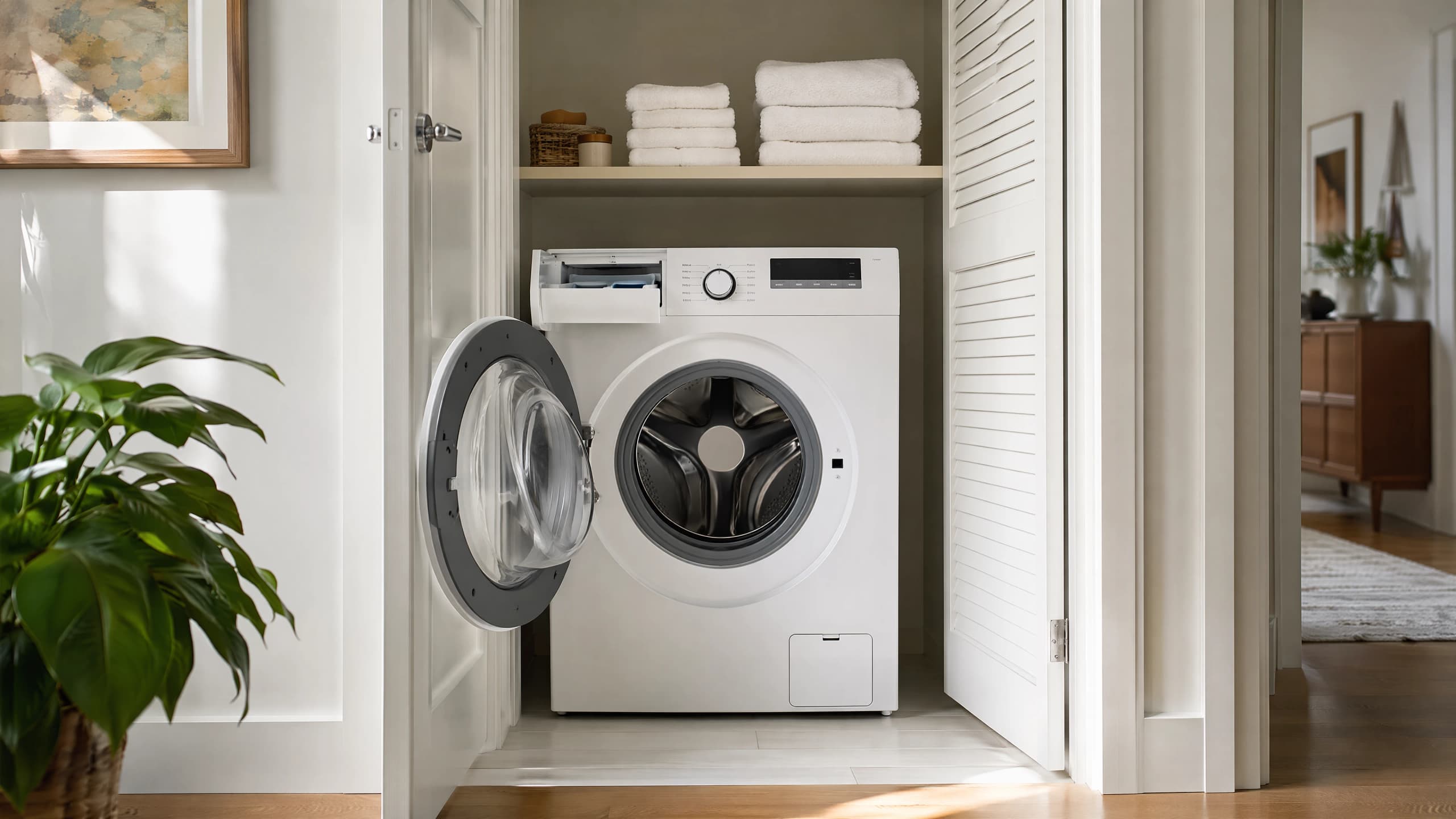
Work with your nose close to each suspect, because a source that owns the whole room at a distance is often unmistakable from ten centimetres. Start with the washing machine: pull back the rubber door gasket on a front-loader and smell the fold. Standing water and lint in that seal are the most common musty source we find in apartments. Worse, that smell rides every load of laundry into your closets.
Next, the fridge. Most fridges have a drip pan underneath or behind the kick plate that collects defrost water, and in a poorly ventilated kitchen corner it grows a biofilm that smells exactly like old basement. Then open every under-sink cabinet and smell the back corners; one historic slow leak leaves particleboard permanently musty long after the plumbing was fixed.
Finally the perimeter: closets and walls that touch concrete or face outdoors. Clothing, cardboard, and mattresses pressed against a cool wall wick condensation every night of the wet season. If a closet smells stronger than the room it is in, whatever is against its back wall is your answer. Bathroom fan ducts and rarely used drains, where the water trap can dry out and let sewer air in, round out the list; a dried trap smells foul rather than musty, which helpfully tells them apart.
- Washer door gasket: peel it back and smell the fold; also run an empty hot wash to confirm
- Fridge drip pan and coil area: the forgotten corner of most kitchens
- Under-sink cabinets: old leak damage in the back corners keeps its smell for years
- Closets on concrete or exterior walls: check whatever touches the back wall
- Bathroom fan and unused floor drains: airflow and dried traps change the smell's character
Pro Tip
Do the sniff test right after being outdoors for half an hour. Your nose fatigues to a smell within minutes of living in it; time outside resets it, and the first two minutes back inside tell you more than the next two hours.
Humidity: The Number That Decides Whether It Comes Back
Every fix in this guide holds only if the unit stops offering microbes a habitat, and that is a humidity number, not a scent.

The target is 30 to 50 percent relative humidity, the range health agencies recommend for keeping mold and dust mites in check. Buy a basic hygrometer, put it in the room that smells, and believe what it says over what the air feels like. Readings above 60 percent through the wet season are an open invitation for everything this guide is trying to evict.
Getting to the number in a Vancouver winter takes deliberate habits: bathroom fan running during and twenty minutes after every shower, kitchen exhaust on while boiling anything, lids on pots. Never air-dry laundry in an unventilated room, and pull furniture a hand's width off cold exterior walls so air can move behind it. A compact dehumidifier does the heavy lifting in units where ventilation cannot, and its tank filling up is the problem becoming visible.
Summer brings its own trap here: wildfire-smoke days force windows shut, and units that rely on open windows for airflow quietly climb into the humid zone for a week at a time. If the musty note appears in August with the windows closed, run the bathroom fan on a timer and the dehumidifier until the air clears.
Basement Suites: The Special Case
A big share of Vancouver's rentals sit below grade, where the physics of cool walls make musty the default rather than the exception.
Below-grade walls stay cool year-round, which means they hit the dew point first: moisture in the room's air condenses on and inside anything touching them. Carpet laid directly on a concrete slab, boxes stored against a foundation wall, and beds pushed into corners all become slow sponges from October onward. That is why basement suites so often smell musty with genuinely clean housekeeping.
The suite-specific playbook: keep storage in plastic bins rather than cardboard, lift what you can onto shelving with air space beneath, leave that hand's width behind furniture on every exterior wall, and give the suite its own hygrometer, because it will read 10 points higher than upstairs. A deep cleaning once or twice a year that moves the furniture, cleans the skirting and closet floors, and treats the washer and kitchen appliances resets the baseline in a way weekly tidying cannot.
Know the limits, too. Efflorescence, that white mineral bloom on concrete, damp carpet that never fully dries, or a tide line on a wall mean water is coming through the assembly, and no amount of cleaning outruns that. Those findings go to the landlord, in writing.
When It Is Not a Cleaning Problem
Some musty smells are the building talking. BC tenancy rules are clear about whose job those are.
If the sniff test keeps leading you to a wall, a ceiling, the carpet itself, or anywhere water could be entering, stop cleaning and start documenting. Plumbing leaks, failed caulking and grout, broken or missing bathroom fans, and water ingress from outside are repairs, and in British Columbia landlords are required to maintain rental units in a state fit for occupation. Housekeeping is the tenant's side of the bargain; the building envelope and its systems are not.
Report the problem in writing with dated photos and keep copies, the same paper trail that protects your damage deposit at move-out. Ask specifically for the moisture source to be found and repaired rather than for the symptom to be repainted. Painting over suspected mold hides the evidence, changes nothing underneath, and makes the eventual fix harder.
The honest boundary matters in the other direction as well. If a crew like ours finds that the smell traces to a gasket, a drip pan, and a damp closet, that is squarely a cleaning problem and one visit ends it. When we find staining that suggests an active leak, we photograph it and hand it to the tenant or owner rather than wiping it down and taking the cheque. Knowing which problem you have is most of the value.
Pro Tip
Musty plus a visible tide line, bubbling paint, or carpet that feels cool and damp days after rain is a building problem. Musty plus none of those is very likely a cleaning problem you can end this weekend.
Keeping It Gone
Once the source is cleaned, staying odour-free is a five-minute weekly habit plus one honest seasonal reset.
Weekly: leave the washer door and detergent drawer open between loads, run the bathroom fan on every shower, and glance at the hygrometer. Monthly through the wet season: an empty hot wash with washing soda or a machine cleaner, a smell check of the under-sink cabinets, and a hand behind the furniture on cold walls. Seasonally: pull the fridge forward and clean the pan and coils, wash closet floors, and rotate anything stored against exterior walls.
If you would rather compress all of that into one visit, an apartment cleaning on a recurring schedule keeps the routine honest, and our teams default to low-odour, eco-friendly products on request, which matters in small units where you live centimetres from every surface we treat. Either way, the goal is the same: no damp spot in the unit that lasts longer than a day.
Step-by-Step
The Weekend Protocol, Step by Step
Six steps, one Saturday, in this order. Most units smell different by Sunday night.
Cross-ventilate and reset your nose
Open opposing windows for twenty minutes, step outside for a few of them, and come back in fresh. You are clearing the accumulated MVOCs so sources stand out individually.
- Open two sides of the unit, not just one window
- Step outside so your nose resets before the hunt
Run the sniff-test order
Washer gasket, fridge drip pan, under-sink cabinets, closets on cold walls, bathroom fan, unused drains. Close-range smelling, in that order, marking every hit.
- Peel the washer gasket fully back with a flashlight
- Smell cabinet back corners, not the open doors
Clean each hit properly
Gasket folds scrubbed and dried, an empty hot wash behind them; drip pan out, washed, and dried; cabinet interiors washed with an appropriate cleaner and left open to dry overnight.
- White vinegar or a dedicated machine cleaner for the washer cycle
- Leave cleaned cabinets and the washer door open overnight
Dry out the closets
Empty any closet that flagged, wash the floor and skirting, and let it dry with the door open. Rehome cardboard to plastic bins and keep contents off the back wall.
- Launder or air fabric items that were against the wall
- Leave a hand's width of air space at the back
Fix the humidity
Hygrometer in the worst room, target 30 to 50 percent, dehumidifier if ventilation alone cannot hold it there through the wet season.
- Fan on during and 20 minutes after showers
- No air-drying laundry in unventilated rooms from October to April
Re-test in 24 hours
Come back from half an hour outside and trust the first two minutes. Clearly better means you found it; unchanged means a missed source or a building problem, and the documentation path starts.
- Improvement: lock in the weekly habits
- No change: re-run the order, then write to the landlord with photos
| Strongest near | Likely source | The fix | Whose job |
|---|---|---|---|
| Laundry area or clean clothes | Washer door gasket and drum biofilm | Gasket scrub plus empty hot wash; door left open between loads | Tenant |
| Kitchen, worse behind the fridge | Fridge drip pan and coils | Pull, empty, wash and dry the pan; vacuum coils | Tenant |
| Inside cabinets | Old slow-leak damage in particleboard | Wash, dry open overnight; liner paper replaced | Tenant, unless leak is active |
| One closet | Condensation on a cold back wall | Empty, wash, dry; bins not boxes; air gap at the wall | Tenant |
| A whole wall, ceiling, or carpet | Water ingress or in-wall growth | Written report with photos; professional inspection | Landlord |
Services mentioned in this article
Ready for help?
4.9 · 800+ Google reviewsWant the Source Found and Gone in One Visit?
P&J Cleaners' deep cleaning crews work through Vancouver rentals, condos, and basement suites with an odour-first checklist that starts at the washer seal and works through the fridge, the cabinets, the closets, and every surface that holds damp. If the smell is cleanable, this is the visit that ends it.
778-720-2224Musty Smell Questions, Answered
Why does my apartment smell musty even after cleaning?
Because the source is somewhere a normal clean does not reach. The usual suspects are the washing machine door gasket, the fridge drip pan, the cabinet under a sink that once had a slow leak, and closet walls that sit against concrete or an exterior wall. Surface cleaning freshens the room; the smell comes back because the damp spot is still damp.
Does a musty smell always mean mold?
No, but it always means microbial activity somewhere. The odour itself is made of compounds released by mold or bacteria growing where you cannot see them, often inside an appliance or behind stored items. Small hidden sources are common and fixable with cleaning; a strong smell paired with staining, bubbling paint, or a known leak deserves a proper mold inspection.
How do I get rid of a musty smell fast?
Cross-ventilate for twenty minutes, then hunt the source instead of masking it. Run the sniff-test order in this guide, clean what you find with an appropriate cleaner, and get indoor humidity between 30 and 50 percent with a dehumidifier or steady ventilation. Most units smell noticeably better within a day of fixing the actual source.
What humidity should my apartment be to prevent the smell?
Between 30 and 50 percent relative humidity, the range health agencies recommend for limiting mold and dust mites. An inexpensive hygrometer tells you where you stand. In Metro Vancouver expect to work for that number from October to April, when outdoor air is saturated for weeks at a time.
When is a musty smell the landlord's responsibility in BC?
When the cause is the building rather than housekeeping: plumbing leaks, failed caulking, broken bathroom fans, missing ventilation, or water getting in from outside. BC landlords must keep rental units in a state fit for occupation, which covers those repairs. Report the issue in writing with photos, keep a copy, and do not paint or cover over suspected mold before it is inspected.
Can a professional deep clean remove a musty smell?
Yes, when the cause is a cleaning problem, and a good crew will tell you when it is not. On odour jobs we typically find two or three small stacked sources rather than one dramatic one, clean each properly, and the smell goes with them. If we find evidence of an active leak or in-wall mold, that gets documented for the landlord instead of hidden.

Meet the Author
Pamela
Co-Founder
Pamela leads residential quality standards at P&J Cleaners, refining safe, detail-driven cleaning systems for Vancouver homes, condos, and move-out projects.
Keep Exploring