


Quick answer
A deep cleaning home checklist covers every task a weekly tidy skips: ceiling fixtures, vents, baseboards, door frames, window tracks, range hood filters, grout, cabinet interiors and behind appliances. Work one room at a time, top to bottom, dry tasks before wet, floors last. A full house takes six to twelve cleaner-hours.

Key Takeaways
- 1Skipping the deep list is not a cleanliness problem, it is a maintenance one. Grease hardens onto range hood filters, grout darkens and gets harder to bring back the longer it is left, and window seals start growing things a weekly wipe was never going to remove.
- 2Sequence beats speed. One room at a time, top to bottom, dry before wet, floors last, and you never clean the same surface twice.
- 3A full-house deep clean runs six to twelve cleaner-hours depending on square footage, pets and how long it has been. Kitchens and bathrooms alone are about half of that.
- 4Metro Vancouver tap water is very soft: the 2024 Greater Vancouver Water District report puts treated hardness at 2.5 to 22.4 mg/L as calcium carbonate, far below the 60 mg/L level at which water is generally classed as soft. The limescale removers that national checklists insist on do very little here.
- 5The BC Residential Tenancy Branch names window tracks specifically: tenants are responsible for cleaning inside windows and tracks during and at the end of a tenancy, including removing mould.
- 6Health Canada puts the target indoor relative humidity at 30 to 50 percent. Above that, condensation on window panes reseeds the mould you just scrubbed out of the tracks.
- 7The 80/20 triage call: floors, eye-level surfaces, glass and the bathroom carry most of the visible result. Do those first when time is short, then work down the detail list.
What Does a Deep Cleaning Home Checklist Include?
A weekly clean is about what people see. A deep clean is about everything a weekly clean has no way of reaching.
The difference between the two is not effort or product. It is the list. A deep clean is defined by the surfaces a routine tidy structurally cannot reach, because something is in the way, it sits above eye level, or it is behind a door.
Pull that thread and the checklist writes itself. Anything that has to be removed, opened, lifted or climbed to belongs on the deep list. Light fixtures come down. Range hood filters come out. The fridge rolls forward. Cabinet shelves get emptied. Window tracks get dug out rather than wiped.
That is also why a deep clean gets priced in hours rather than per room, and why the quotes vary so much between homes of the same size. If you want the arithmetic behind that, we broke down what a deep clean costs in Metro Vancouver and where the hours actually go.
- Above eye level: ceiling fixtures, fan blades, vent covers, the top edge of door frames and upper cabinets
- Behind and under: fridge, stove, sofas, beds, the toilet base and its bolt caps
- Inside and open: cabinet and drawer interiors, the oven, medicine cabinets, closet floors
- Edges and seams: baseboards, grout lines, tile edges, window tracks, the silicone bead around tubs and sinks
- Small and forgotten: switch plates, door handles, remote controls, stair spindles, baseboard heater fins
Pro Tip
Photograph each room from the doorway before you start, then look at the photo on your phone rather than at the room. Estimators do this on every walkthrough, because a small screen flattens a room and the greasy cabinet edge and furred vent cover stop hiding behind everything else you own.
In What Order Should You Deep Clean a House?
Sequence is what separates a deep clean that flows from one that keeps doubling back. Most of the rules below exist to stop you cleaning the same surface twice; the rest exist to stop you cleaning around your own belongings.
Start with a declutter lap. One basket, every room, anything that does not live there goes in it. Cleaning around objects is the biggest single time sink in a DIY deep clean, and it is exactly why a professional crew asks you to clear the counters before they arrive.
Then commit to one room at a time. There is a long-running argument online about room-by-room versus task-by-task, and for a weekly clean, task-by-task genuinely wins: one pass with the duster, one with the vacuum, done. For a deep clean it loses badly, because the task list per room is thirty items long and you will lose your place. Finish the kitchen, close the door, move on.
Inside each room, work top to bottom and dry before wet. Dust falls. Mop before you dust the ceiling fan and you will mop twice. Doing dry tasks first also means crumbs and grit get vacuumed away instead of turning into a smear the moment they meet a damp cloth.
Floors last, always, working backwards toward the door so you are never standing on what you just finished. In a two-storey house that means starting upstairs and ending at the front mat.
- Declutter lap with one basket, whole house, before any cleaning starts
- Strip the beds and start the first laundry load so it runs while you work
- One room at a time, door closed behind you when it is finished
- Top to bottom: ceiling fixtures, then walls and frames, then furniture, then baseboards
- Dry before wet: dust and vacuum first, then spray and wipe
- Give the kitchen and bathrooms the longest blocks, while you still have energy
- Floors last, backwards toward the door, upstairs before downstairs
Pro Tip
Spray the oven, the shower grout and the range hood filter first, then walk out and start dusting. Dwell time does the scrubbing for you, and those are the jobs where twenty minutes of waiting takes the most work out of the scrub.
The Deep Cleaning Supplies Checklist (and the One Vancouver Homes Can Skip)
A short kit, two genuine specialist items, and one product that national checklists insist on and Metro Vancouver barely needs.
The core kit is short and unglamorous. You are buying for two jobs only: cutting grease, and cutting soap film. Everything after that is a brush shaped to reach something a cloth cannot. The full list is below, and if you already own most of it, the two things actually worth a trip are a real grout brush and a step stool.
Now the local part. Almost every deep cleaning supplies checklist online is written for hard water and tells you to buy a descaler for the kettle, taps, shower glass and toilet. Metro Vancouver water does not work that way. The 2024 Greater Vancouver Water District water quality report puts treated hardness at 22.4 mg/L as calcium carbonate from the Capilano system, 22.3 from Seymour and 2.5 from Coquitlam. Water is classed as soft below 60. Ours is very soft.
So the white film on your shower glass here is almost never mineral scale. It is soap scum and body oil. That is why a descaler bounces off it and a cream cleanser lifts it in one pass. The time a national checklist spends fighting limescale is better spent on mould, which is the problem this city actually has.
One safety rule is worth more than the rest of this section combined. Never mix household bleach with another product. The Canadian Centre for Occupational Health and Safety singles out cleaners containing ammonia: the mix produces toxic gases that are very irritating or corrosive to the eyes and lungs. Plenty of glass cleaners are ammonia-based, and a bathroom is a small room with the door shut. One chemistry per surface, and open a window.
- Microfibre cloths in two colours minimum, with bathroom and kitchen cloths never shared
- Degreaser for the kitchen, cream cleanser for tubs, tile and shower glass
- One grout brush plus two or three detail brushes for tracks, seams and tap bases
- Vacuum with a crevice tool and a soft brush head for vents and baseboards
- Flat mop with several washable pads, so you are never mopping with a grey pad
- A step stool you will actually use, because the top third of every room is on the deep list
- Skip the dedicated limescale remover. In soft-water Metro Vancouver it has almost nothing to do.
Pro Tip
Buy the cheapest stiff detail brushes you can find and cut the bristles down to about half length with scissors. Short bristles do not splay under pressure, and a stubby brush is the one tool that reliably gets the corner of a window track properly clean.
Window Tracks, Sills and Why the Mould Keeps Coming Back
The one part of a deep clean a national checklist cannot write for you, and the part a BC landlord will inspect.
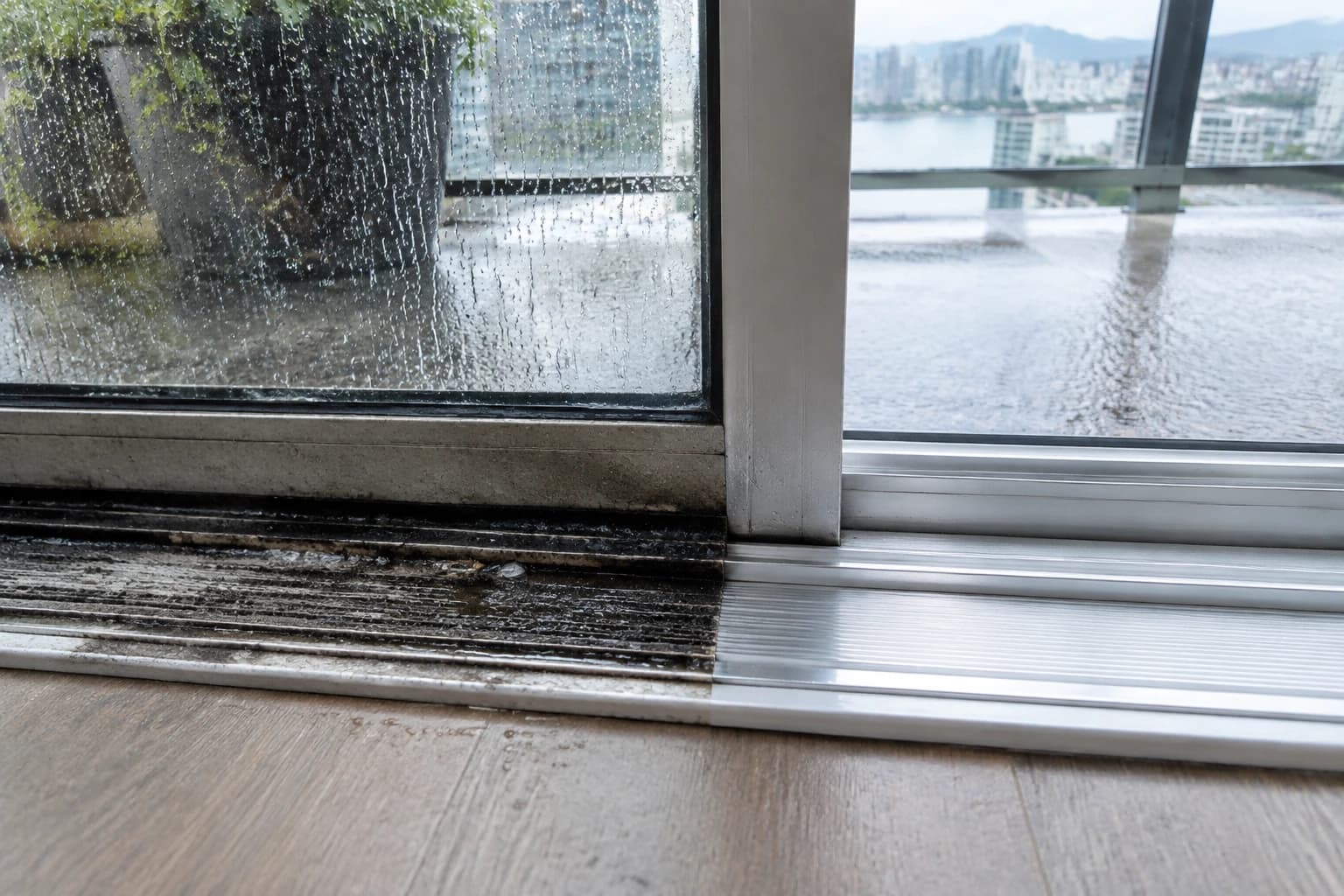
On Metro Vancouver jobs our crews spend time on window tracks that would be close to pointless in Calgary. Warm indoor air meets cold glass, condensation runs down into the track, and the track holds that water against a bed of dust. That is a growing medium. By February there is black spotting in the corner of the sill and along the rubber seal. Homes under tree cover run damper again, and plenty of North Vancouver sits under it.
If you rent, this is not optional housekeeping. BC Residential Tenancy Branch Policy Guideline 1 states that the tenant is responsible for cleaning the inside windows and tracks during, and at the end of, the tenancy, including removing mould. The same guideline puts balcony door glass and tracks on the tenant inside and out, and requires baseboards and baseboard heaters to be wiped or vacuumed. That is the written standard both sides are working from at the final inspection, so it is worth reading the section that covers your suite rather than taking our word for it.
Cleaning the track is the easy half. Stopping it coming back is the half most guides skip entirely. Health Canada's guidance on moisture and mould indoors is to hold indoor relative humidity between 30 and 50 percent. Run a dehumidifier if it climbs above 50, or if moisture is condensing on cold surfaces like window panes. Scrub the track in November and change nothing else, and you will be scrubbing it again in January.
Exterior glass is a separate job and a separate risk. Anything above ground level is worth handing to a window cleaning crew with the right access gear rather than a ladder and optimism. If the spotting has already spread from the track onto the frame and seal, we wrote a full method for getting mould off window frames.
- Vacuum the track dry first with a crevice tool, then work a damp stubby brush along it, then wipe out the slurry. Going in wet turns dust into mud and doubles the job.
- Clear the weep holes at the outboard edge of the track. Blocked weeps hold standing water all winter.
- Wipe the rubber seal and the bottom of the frame, not just the channel, because the spotting usually starts on the seal
- Run the bathroom fan for twenty minutes after every shower, and the range hood whenever you boil or fry
- Leave blinds and curtains open during the day so warm air can actually reach the glass
- Keep furniture off baseboard heaters, so the room's driest air is not trapped behind a sofa
Pro Tip
Put a cheap hygrometer in the room with the worst windows, not in the hallway. Most Vancouver homes with a mould problem do not have a whole-house humidity problem. They have one cold north-facing bedroom sitting ten points above everywhere else.
What Is the 80/20 Rule in Housekeeping?
The Pareto principle applied to a room: a small share of the tasks carries most of the visible result. Useful for triage, dangerous as a philosophy.
The 80/20 rule in housekeeping borrows the Pareto principle from economics: roughly 20 percent of the work delivers roughly 80 percent of the perceived result. It is a rule of thumb, not a measurement, and the exact ratio does not matter. What matters is that cleaning tasks are not equal.
In practice four things carry a room: the floor, the horizontal surfaces at eye level, the glass and mirrors, and in a bathroom the toilet and shower. Do those and a visitor reads the whole home as clean. Everything else on the deep list is about how the home ages, not how it photographs on Saturday.
Which is exactly why 80/20 is a scheduling tool, not a cleaning method. Use it when you have ninety minutes and someone is on their way. Do not let it become the only routine, because the deferred 80 percent is where grout goes grey, range hood filters load up with hardened grease and the black spotting starts in the window seals. A deep clean is the scheduled payment on everything 80/20 lets you put off, and a seasonal spring clean is usually where that debt gets cleared.
- The 20 percent, in order: floors, eye-level surfaces, glass and mirrors, toilet and shower, then a fast declutter
- The deferred 80 percent is where damage accumulates: grout, filters, tracks, vents, behind appliances
- Two to four deep cleans a year is roughly what it takes to stop the deferred list compounding
Pro Tip
When a client caps us at two hours, we run the same four things every time: the bathroom, every mirror and glass surface, the kitchen floor, and the entry. We skip dusting completely. Almost nobody comments on the dusting afterwards, and almost everybody comments on the bathroom.
How Long a Deep Clean Takes, and When DIY Stops Being Worth It
Real cleaner-hour estimates by home size, and the honest arithmetic on doing it yourself.
A deep clean is measured in cleaner-hours, not clock hours. Two cleaners working four hours is eight cleaner-hours. That is the number to hold against your own weekend.
These next figures are our own crew estimates from Metro Vancouver jobs rather than a published standard, so treat them as a planning range, not a quote. For a home that has had regular upkeep, budget roughly six to eight cleaner-hours for a one or two bedroom condo, and eight to twelve for a three bedroom house. Add more for pets, for a smoker, or if it has been over a year. Kitchens and bathrooms are typically half the total on their own, and a single neglected kitchen can absorb three hours before you touch the rest of the home.
Doing it yourself is genuinely worth it if you enjoy the work, you are spreading it across several weekends a room at a time, or the home is small and well maintained. It stops being worth it somewhere past the ten-hour mark. By then the constraint is not skill, it is equipment and stamina: reaching the top of a three-metre wall, moving a fridge without scoring the floor, and still having enough left at hour nine to do the floors properly.
That is the point where people call us, and this is the list our deep cleaning service works from, with the heaviest items on it (inside oven, range hood degrease, baseboards and window sills) priced as optional add-ons rather than quietly assumed. If you are cleaning to get a damage deposit back instead, a move-out clean runs the same list against the Residential Tenancy Branch guideline, with the oven and fridge interiors included rather than priced as add-ons.
- One or two bedroom condo, well maintained: 6 to 8 cleaner-hours
- Three bedroom house, well maintained: 8 to 12 cleaner-hours
- Any home more than a year since its last deep clean: add 30 to 50 percent
- A neglected kitchen on its own: 2 to 3 hours
- Each bathroom: 45 to 90 minutes
Pro Tip
If you are deep cleaning to recover a damage deposit, book it for after the furniture is out, never before. In our experience an empty suite cleans in roughly two thirds of the time, and it is the only reliable way to reach the baseboards, window tracks and floor edges the Residential Tenancy Branch guideline actually names.
Step-by-Step
The Room-by-Room Deep Cleaning Home Checklist
Every task below is on the deep list because a weekly clean cannot reach it. Work one room at a time, top to bottom, and finish each room before you open the next door. Not every line applies to every home. The times are for the room itself and they scale with how many bedrooms and bathrooms you have: a well kept one or two bedroom condo adds up near the bottom of the six to twelve cleaner-hour range, and a three bedroom house lands in the upper half of it. The declutter lap, the laundry, and setting up and packing down sit on top of the room times.
Kitchen
The longest room on the list, and the one where a deep clean genuinely changes how the space works. Budget two to three hours if it has been a while.
- Spray the oven interior and leave it to dwell before you touch anything else
- Pull the range hood filter and soak it in hot water with degreaser. It is the most skipped task in the house.
- Degrease cabinet fronts, especially the two either side of the stove, and the undersides of the upper cabinets
- Empty upper cabinets and drawers, vacuum out the crumbs, wipe the shelves, then restock
- Work the backsplash grout with a brush rather than a cloth
- Wipe the top of the fridge and the upper cabinet ledges, which are pure grease and dust
- Roll the fridge and stove forward and clean the floor and wall behind and underneath
- Descale the kettle only if there is visible buildup. Vancouver water rarely produces any.
- Clean the sink, then the taps and their bases, then run hot water through
- Wipe switch plates, handles, and the bin lid inside and out
- Baseboards, then the floor edges, then the floor
Bathrooms
The highest payoff per minute in the house, and the first room a landlord, a buyer or a guest forms an opinion in. Allow 45 to 90 minutes per bathroom.
- Spray grout, shower glass and the toilet, then leave the room for twenty minutes
- Take down the extractor fan cover, vacuum the grille and wash the cover
- Work grout lines with a brush, top row down, then rinse the whole wall
- Cut the soap film off the shower glass with a cream cleanser. A descaler will not touch it here.
- Clean the silicone bead where the tub or tray meets the tile and check it for black spotting
- Empty the under-sink cabinet, wipe it out, and check the trap for a slow leak
- Clean the toilet base, the bolt caps and the wall behind it, not just the bowl
- Polish the mirror and the taps last, so you are not respraying them
- Wipe the door, handle and light switch
- Baseboards, then the floor, finishing at the door. Our full method is in the bathroom deep clean guide.
Bedrooms
Fast rooms with two slow tasks hiding in them: under the bed, and the closet floor. Allow 30 to 45 minutes each.
- Strip the bed and start the wash before you clean anything else
- Dust the light fixture and any fan blades first
- Wipe the tops of door frames, then the door and the handle
- Move the bed and vacuum underneath, including along the skirting behind it
- Clear the closet floor, vacuum it, and wipe the shelf edges and the rail
- Wipe the headboard, bedside tables and drawer fronts
- Rotate or flip the mattress if the manufacturer allows it, and vacuum the seams
- Clean the window interior, the track and the sill
- Wipe switch plates and any vent covers
- Baseboards, then the floor
Living and dining areas
Mostly a height and furniture-moving job. The dust here is older than anywhere else in the home. Allow 45 to 75 minutes.
- Ceiling fixtures, fan blades and the tops of tall furniture first
- Vacuum vent covers and wipe the grilles
- Move the sofa and chairs, vacuum underneath, then the frames and under the cushions
- Wipe the tops of door frames, picture frames and shelf edges
- Clean window interiors, tracks and sills, plus the balcony door channel
- Wipe the TV surround, remote controls, switch plates and handles
- Dust stair spindles and the handrail, working top to bottom
- Clean baseboards and any baseboard heater fins
- Vacuum, then mop, working backwards toward the exit
Entry, hallways and stairs
Small square footage, heavy traffic, and the first thing anyone sees. In the wet season this is where the grit lives. Allow 30 to 45 minutes.
- Take the mats outside, beat them, and clean the floor underneath
- Wipe the inside of the front door, the frame, the handle and the deadbolt
- Clean the light fixture and the top of any coat rail
- Empty the shoe storage, vacuum out the grit, wipe it and restock
- Wash scuff marks and handprints off the walls at hand and shoulder height
- Vacuum stair treads including the back corner of each step, then the risers
- Clean the handrail and the spindles
- Baseboards along the full run, then the floor
Laundry and utility
The room everyone forgets, and the one with a genuine safety item on the list. Allow 20 to 30 minutes.
- Wipe the exterior and the top of the washer and dryer
- Clear the lint trap housing, not just the screen, and vacuum out the cavity
- Check that the dryer vents to the outside and that the duct joints are sealed
- Pull the machines forward if they sit on a hard floor and clean behind them
- Scrub the utility sink and tap base, then the wall behind it, which usually has more splash on it than the sink does
- Clean around the floor drain if there is one
- Dust the top of the water heater and clear anything stored against it
- Wipe the shelves, then the floor
| Area | Weekly clean covers | Deep clean adds | How often |
|---|---|---|---|
| Kitchen | Counters, sink, stovetop, floor | Range hood filter, cabinet fronts and interiors, backsplash grout, behind and under the fridge and stove | Every 3 to 6 months |
| Bathroom | Toilet, sink, mirror, quick shower wipe | Grout lines, shower glass film, extractor fan cover, under-sink cabinet, silicone beads | Every 3 months |
| Bedrooms | Dust surfaces, vacuum, change bedding | Under the bed, closet floors, door frames, baseboards, light fixtures, mattress rotation | Every 6 months |
| Living areas | Tidy, dust, vacuum | Ceiling fixtures and fan blades, vent covers, behind and under furniture, window interiors | Every 6 months |
| Windows and tracks | Spot-clean the glass | Full track scrub, sill mould removal, frame and seal wipe, balcony door channel | Every 3 months in Metro Vancouver |
| Whole home, time | 2 to 3 hours | 6 to 12 cleaner-hours | 2 to 4 times a year |
Services mentioned in this article
Ready for help?
4.9 · 850+ Google reviewsWant This Checklist Run For You?
A full deep clean is six to twelve cleaner-hours of reaching, moving and detail work. Our Metro Vancouver crews work this same list in this same order, with the heaviest items (inside oven, range hood degrease, baseboards and window sills) available as add-ons. Backed by our satisfaction guarantee.
778-720-2224Deep Cleaning Checklist Questions
In what order should you deep clean a house?
Declutter the whole house first, then work one room at a time rather than one task at a time. Inside each room, go top to bottom and dry before wet: ceiling fixtures, then walls and door frames, then furniture, then baseboards, then floors last, working backwards toward the door. In a two-storey home, start upstairs and finish at the front mat.
What should be included in a home deep clean?
A home deep clean should include everything a weekly clean cannot reach, in four groups. Above eye level: ceiling fixtures, fan blades, vent covers, the tops of door frames. Behind and under: the fridge, the stove, sofas, beds. Inside and open: cabinet and drawer interiors, and the oven. Edges and seams: baseboards, grout lines, window tracks, silicone beads. Kitchens and bathrooms usually account for about half the total time.
What is the 80/20 rule in housekeeping?
The 80/20 rule in housekeeping is the Pareto principle applied to cleaning: roughly 20 percent of tasks produce about 80 percent of the visible result. Floors, eye-level surfaces, glass and the bathroom do most of that work. It is a useful triage tool when time is short, but it is not a substitute for deep cleaning, because the deferred tasks are exactly where damage accumulates.
How long does a full-house deep clean take?
Between six and twelve cleaner-hours for most Metro Vancouver homes. A well-maintained one or two bedroom condo runs six to eight, and a three bedroom house eight to twelve. Add 30 to 50 percent if it has been more than a year, and more again for pets or a smoker. Two cleaners working four hours is eight cleaner-hours, not four.
What is the difference between deep cleaning and regular cleaning?
Regular cleaning is defined by what is visible; deep cleaning is defined by what is reachable. A deep clean adds anything that has to be removed, opened, lifted or climbed to: range hood filters, light fixtures, cabinet interiors, the space behind appliances, and window tracks. It is also sequenced so that no surface ever gets cleaned twice.
How often should you deep clean your home?
Two to four times a year suits most homes. Kitchens and bathrooms are on a three to six month rhythm, while bedrooms and living areas are fine at six months. In Metro Vancouver, window tracks and sills earn a quarterly pass because winter condensation restarts mould growth here faster than it does in drier provinces.
Sources & References
The facts in this guide come from the primary sources below. Links open in a new tab.
- 1Residential Tenancy Policy Guideline 1: Landlord & Tenant Responsibility for Residential PremisesBC Residential Tenancy Branch
- 2Guide to addressing moisture and mould indoorsHealth Canada
- 3Greater Vancouver Water District 2024 Water Quality Annual ReportMetro Vancouver
- 4Bleach (Household chlorine): Working SafelyCanadian Centre for Occupational Health and Safety

Meet the Author
Pamela
Co-Founder
Pamela leads residential quality standards at P&J Cleaners, refining safe, detail-driven cleaning systems for Vancouver homes, condos, and move-out projects.
Keep Exploring