

Quick answer
Eco-friendly post-construction cleaning works by capturing dust rather than dissolving it. Seven things change the outcome, roughly in order of impact: the hazardous materials survey BC requires before any renovation, true HEPA vacuuming instead of sweeping, wet wiping with reusable microfibre, third-party certified products, ventilation for off-gassing, a staged top-down clean, and sorted debris disposal.

Key Takeaways
- 1WorkSafeBC's regulation puts a hazardous materials survey before any renovation or demolition that brings a crew on site in BC, with no exemption for newer buildings, and it names the owner alongside the employers doing the work as responsible for making sure it happens.
- 2Dry sweeping and pressurized air blowing, the two moves most DIY cleanups start with, are named in WorkSafeBC's own list of ways respirable silica gets released into the air.
- 3HEPA is a specification, not a marketing word: 99.97 percent capture at 0.3 microns. A shop vacuum without that rating picks dust off the floor and exhausts the finest, most inhalable fraction straight back into the room at speed.
- 4Health Canada's residential guideline for formaldehyde is 123 micrograms per cubic metre over one hour and 50 micrograms per cubic metre over eight hours. No cleaning product lowers those numbers; air exchange and time do.
- 5Health Canada puts formaldehyde in Canadian homes between 2.5 and 88 micrograms per cubic metre, averaging 30 to 40. That is the baseline for a lived-in house, and a renovation adds the exact adhesives, coatings and millwork Health Canada names as sources.
- 6Two certifications carry weight on a cleaning product, ECOLOGO and Green Seal GS-37, because both test performance as well as toxicity and biodegradability. An unregulated plant-based label promises nothing about whether it works.
- 7BC became the first province in Canada to license asbestos abatement, effective 1 January 2024, with mandatory contractor licences and worker certification.
The survey BC law puts on the owner, not just the contractor
The greenest decision in a Vancouver renovation cleanup is not a product. It is finding out what is in the dust before anyone stirs it up.
- WorkSafeBC is blunt about this: asbestos was widely used in BC as a building material until the early 1990s, and you cannot tell whether a material contains it by looking. Once disturbed, the fibres can stay airborne for hours.
- That matters enormously here. Large parts of East Vancouver, Burnaby and the North Shore went up while asbestos was still standard building material, and because nobody can identify it by sight, a character-home renovation has to be treated as containing some until a qualified person says otherwise.
- The part almost nobody tells homeowners: section 20.112 of the Occupational Health and Safety Regulation requires a qualified person to inspect for hazardous materials before work starts on a renovation or demolition, take representative samples where that is practicable, and produce a written report. It is workplace law, so it bites the moment anyone is hired to do the work, and there is no build-year cutoff in it, so a 2005 house is not exempt. The duty also sits on the owner, not only on the employers. If you own the place, that is your name on the obligation.
- If asbestos turns up, the work belongs to a licensed abatement contractor, not a cleaning company. Since January 2024 those contractors have needed a WorkSafeBC licence and certified workers. We will not touch a site that has not cleared that step, and no reputable crew should.
Quick Win
Ask your contractor for the survey report itself, not a verbal all-clear. If asbestos was found and removed, there should also be a clearance letter from a qualified person confirming the air is safe. That letter is what a cleaning crew needs to see before scheduling.
Eco-friendly post-construction cleaning starts with true HEPA, never a broom
Post-renovation dust is ground gypsum, sanded coatings and silica from concrete, tile and mortar. Sweeping does not remove it, it relaunches it.
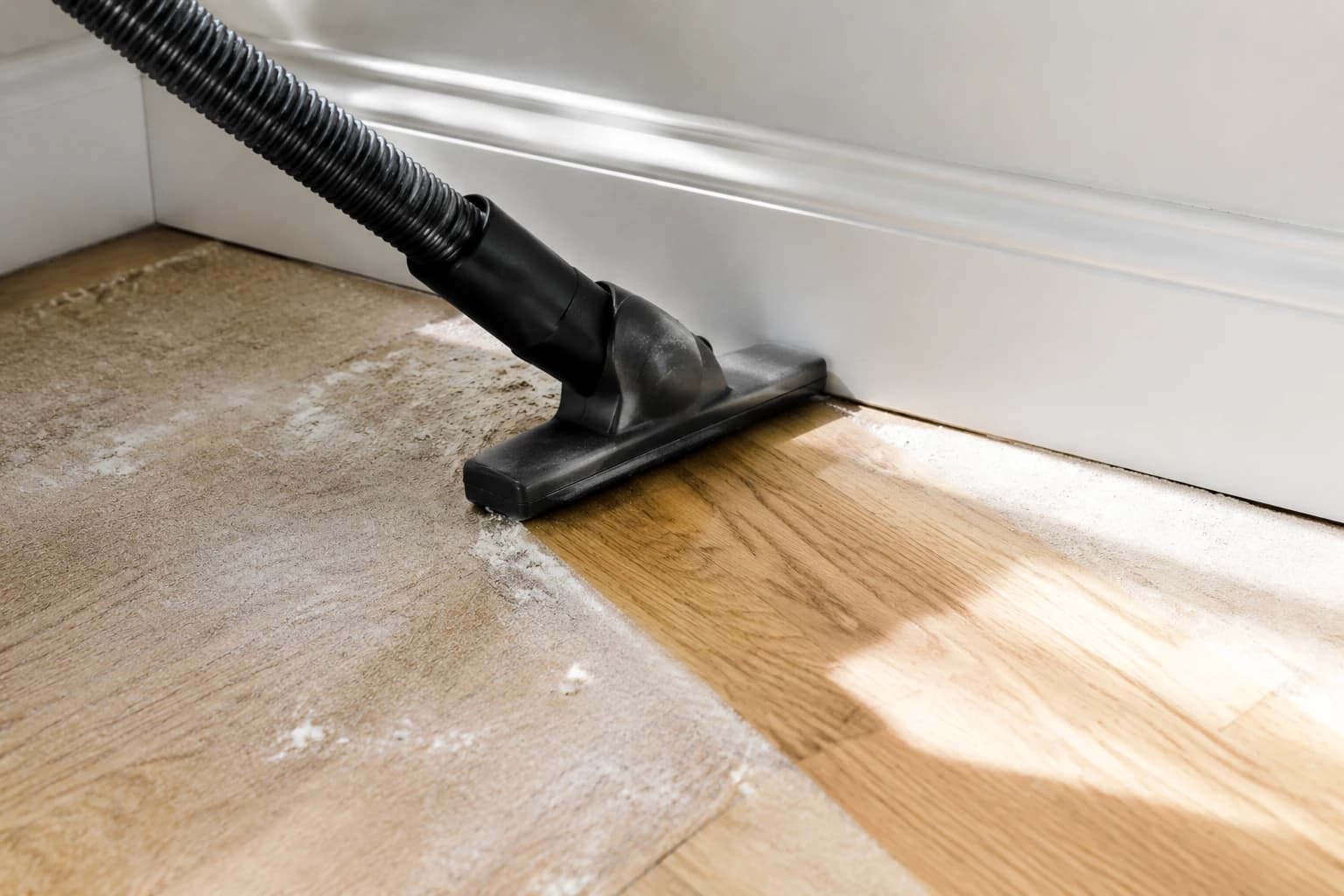
- WorkSafeBC's silica guidance names concrete, cement, mortar, masonry, tile and brick as silica-bearing materials, and it lists dry sweeping and pressurized air blowing among the most common ways that dust gets released. Inhaled, respirable silica can cause silicosis, which is irreversible, and lung cancer.
- Read that list again and picture the usual Saturday cleanup: a push broom, then a leaf blower on the balcony. That is the single least eco-friendly thing you can do in the space, and it costs nothing to avoid.
- A true HEPA filter captures 99.97 percent of particles at 0.3 microns, which is the size range that stays suspended and reaches deep into the lungs. A standard shop vacuum without HEPA does something worse than nothing: it picks dust up off the floor and exhausts the finest fraction back into the room at speed.
- Vacuum first, everywhere, before any liquid touches a surface. Gypsum dust plus water makes a grey slurry that sets into grout lines and hardwood grain. Digging it back out is the kind of deep clean nobody budgeted for, and it is why every post-construction cleaning job we run starts dry.
Quick Win
Run the HEPA vacuum over the walls, not just the floors. Flat and matte paints hold a visible film of drywall dust that a damp cloth will smear into streaks, and once you have streaked a matte wall the only real fix is repainting. If you are doing this pass yourself, wear a well-fitted N95 and eye protection, and get a second person for ceilings and high trim. You are deliberately putting settled dust back into motion.
Wet methods and microfibre beat spray-and-wipe chemistry
The lowest-impact way to move construction dust is water, mechanical friction and a cloth you will wash and use again.
- Once the HEPA pass is done, most remaining residue is mineral dust and light adhesive haze. That comes off with warm water, a mildly alkaline certified cleaner and a microfibre cloth folded into quarters, which gives you eight clean faces before it needs rinsing.
- Microfibre works by capillary action rather than solvency: the fibres lift and trap particles off the surface instead of dissolving them. Practically, that means you need less product, not a stronger one. Non-toxic post-renovation cleaning is mostly that trade, less chemistry and more friction.
- Disposable wipes are the quiet failure here. A post-reno clean on a mid-size home can burn through a few hundred of them, and every one is a single-use plastic-blend sheet carrying solvent into the bin.
- Change water often, and change it before it turns grey. Cleaning a granite countertop with a bucket of gypsum suspension is just polishing the stone with abrasive.
- That is how we run an eco-friendly clean: one certified all-purpose product, a stack of clean cloths, hot water, and a bucket emptied more often than feels necessary. A shelf of specialist sprays usually means someone is compensating for a bad first pass.
Quick Win
Never put construction microfibre through your household laundry, and never let fabric softener near it. Softener coats the fibres and kills the capillary grip that makes them work, and gypsum grit shreds the cloth and settles in your washer's drain pump. Rinse them in a bucket outside first, then hot wash them on their own with no softener and no dryer sheet.
Certification is the only word on the bottle with a definition behind it
'Natural', 'green' and 'plant-based' are marketing terms with no enforceable definition. Two labels actually mean something.
- Two logos on a bottle are worth reading, and the rest is decoration. Green Seal's GS-37 covers general-purpose, bathroom and glass cleaners against criteria for toxicity, biodegradability and packaging. UL's ECOLOGO works the same way on human-health and environmental-toxicity grounds. If you are choosing products for the whole house rather than one cleanup, how to choose eco-friendly cleaning products goes further on the labels.
- Both standards also require performance testing, which is the part the bottle never advertises. A certified cleaner has to work at least as well as a conventional equivalent. That is exactly the gap that makes people abandon green products halfway through a job and reach for something harsh.
- Vinegar is not the answer to everything, and it is genuinely wrong on some renovation surfaces. Acetic acid etches natural stone, and on fresh grout or an unsealed concrete finish it will dull the surface you just paid to have installed.
- Paint is the one place where Canada does the certifying for you. The federal VOC Concentration Limits for Architectural Coatings Regulations cap volatile organic compounds by category of paint, stain and varnish. Ask your painter which product line actually went on the walls, rather than reading low-VOC into the design of the tin.
Quick Win
Check the certification against the registry, not the bottle. Both ECOLOGO and Green Seal publish searchable lists of currently certified products, and a label can outlive the certification behind it.
Ventilate for off-gassing, because no cleaner removes VOCs
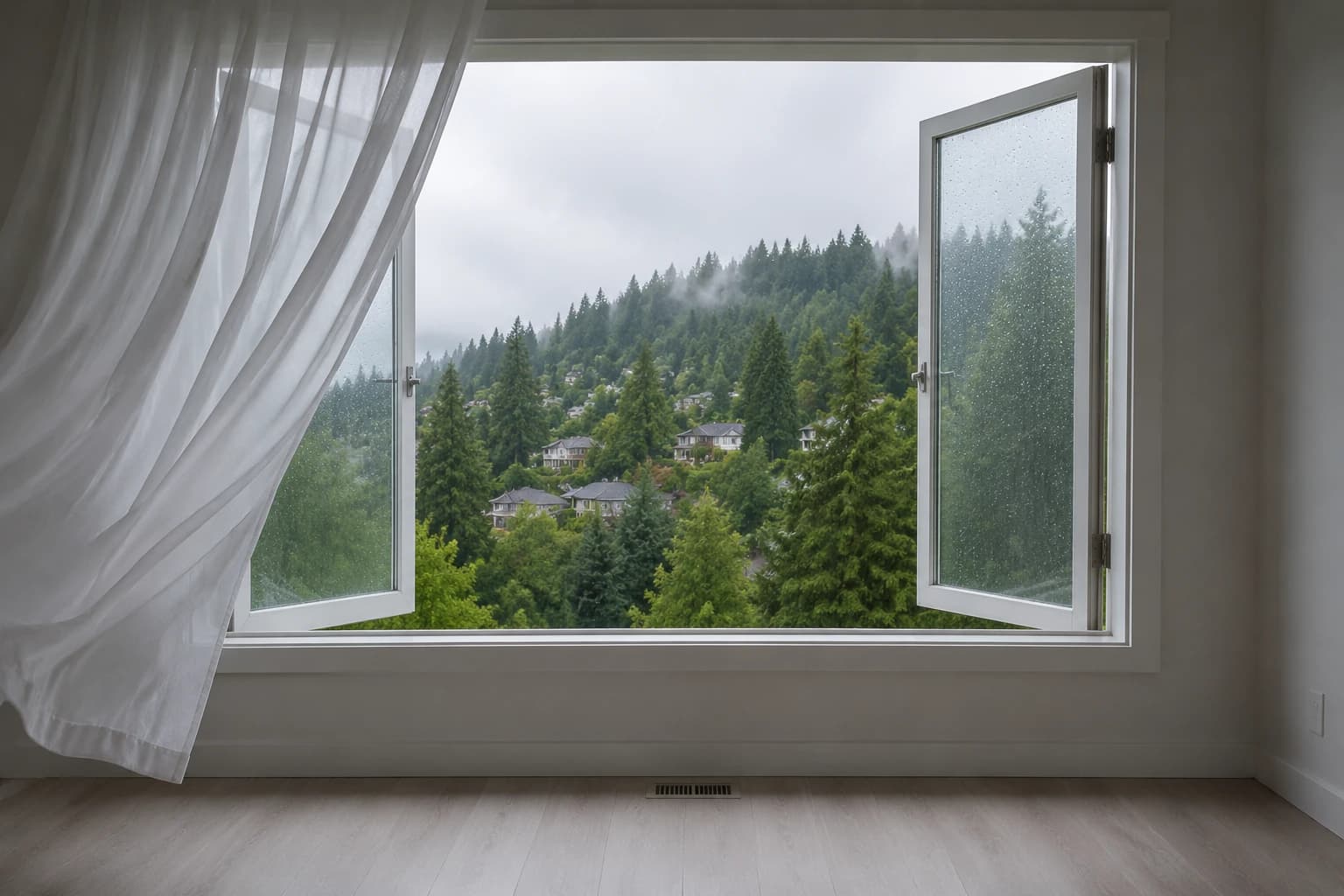
This is the point where the whole product conversation stops helping. Post-renovation indoor air quality is decided by air exchange, not chemistry, and you cannot wipe off-gassing off a surface.
- That smell has a number attached to it. Health Canada's residential guideline caps formaldehyde at 123 micrograms per cubic metre over one hour, a threshold set on eye irritation. The eight-hour limit is 50, set on respiratory symptoms in children.
- Health Canada also names where the stuff comes from, and the list reads like a renovation invoice: particle board and other building materials made with formaldehyde-containing adhesives, plus some varnishes, paints, carpeting, drapes and curtains.
- For scale, formaldehyde in Canadian homes normally measures between 2.5 and 88 micrograms per cubic metre with an average of 30 to 40. That is the baseline for an ordinary lived-in house. A renovation installs the exact sources on Health Canada's list all at once, which is why the weeks after the trades leave are when ventilation earns the most.
- Vancouver makes this harder than the American guides admit. For much of the year, opening the windows means letting the weather in. And our newer builds and deep retrofits are sealed tight for energy performance, so the envelope keeping your heating bill down is also holding the off-gassing in.
- The practical version has three parts. Run the HRV, or the bathroom and range fans, continuously through the first few weeks. Cross-ventilate hard on any dry day, even if you only get twenty minutes. And leave interior doors, closets and cabinets standing open, because the millwork behind them is doing most of the off-gassing.
Quick Win
Warm the space before you ventilate. Off-gassing generally picks up as a room gets warmer, so bumping the heat a few degrees for a couple of hours with the doors between rooms open, then cross-ventilating, tends to clear far more than the same window time in a cold house.
Stage the clean so you only do it once
Sequencing is an environmental decision, not just a scheduling one. Clean in the wrong order and you clean twice, which doubles the water, the product and the hours.
- Fine dust stays airborne for hours after the trades leave. Cleaning the moment the last tool is packed guarantees a second visit, because everything you just wiped will have a fresh grey film on it by morning. Two visits is also the fastest way to double what the clean costs you.
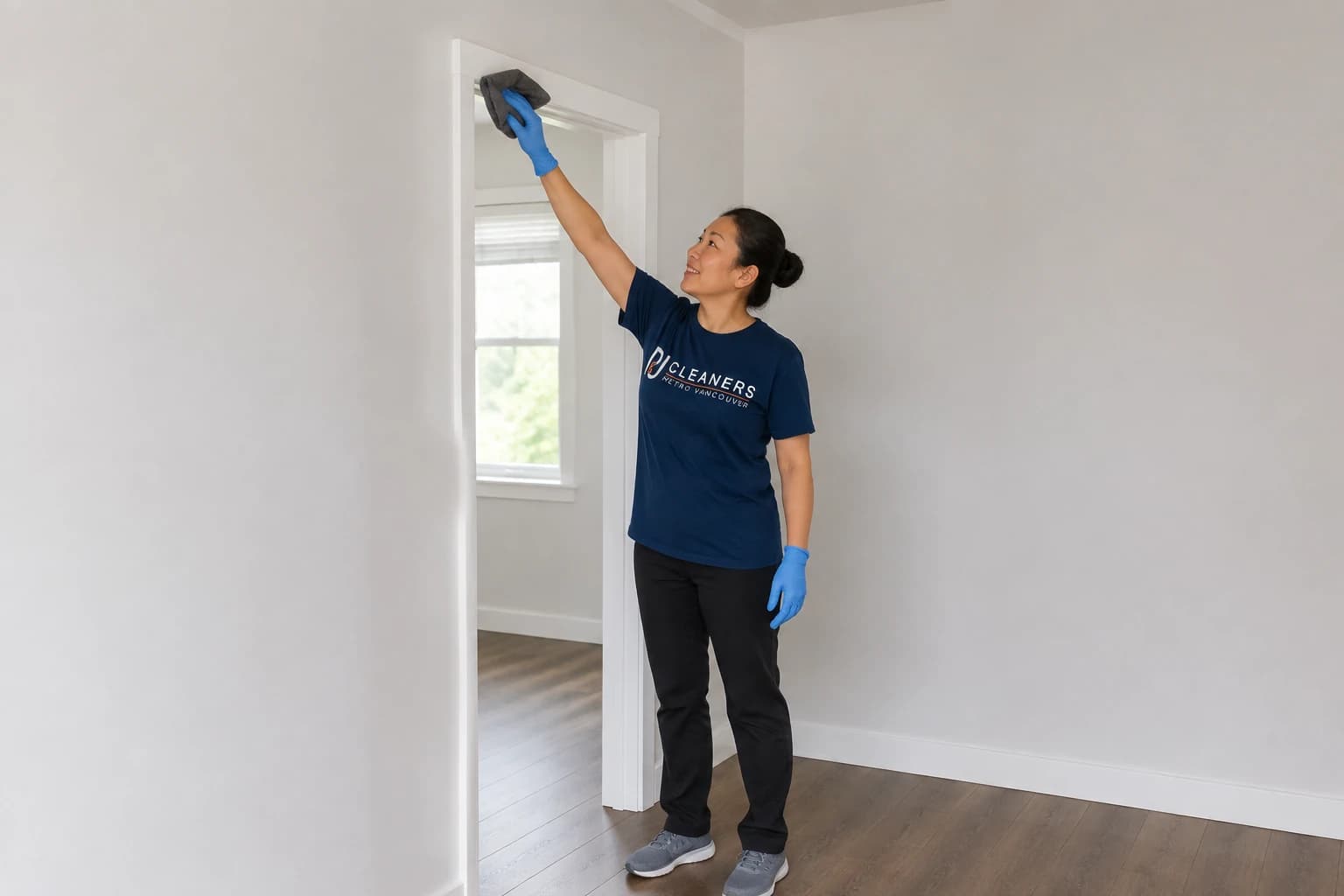
- Let the space settle, then work strictly top to bottom, ceilings and fixtures down to floors dead last. Every stage drops debris onto the one below it, so any other order is rework. Windows and door tracks earn their own pass at the very end, because construction grit in a sliding track is what destroys the rollers.
- Our crews book around the trades instead of waiting politely at the end of them. One rough clean once the drywall sanding is finished, one final clean after the last trade, beats three visits chasing the same film. The room-by-room checklist sets out the full order, and the phased approach shows where that rough clean pays for itself.
Quick Win
Change the furnace filter after the final clean, then again a month later. Better still, put a cheap one in before the trades start if the system will be running at all. The blower has been pulling drywall dust through the ducts for the whole project, and a loaded filter quietly re-seeds every room you just finished.
Sort the debris before it becomes landfill
Count a renovation's footprint by weight and the cleaning products disappear entirely. What is left is bins: gypsum offcuts, packaging, old fixtures and whatever the trades stacked in the driveway.
- Start with the bins, because that is where the weight is. The City's Green Demolition Bylaw sets minimum reuse and recycling rates by weight when a pre-1950 house comes down: 75 percent, rising to 90 percent for houses the City deems character houses.
- Renovations are not held to that bar, but the infrastructure it created is available to you anyway. Clean gypsum, untreated wood, metals and cardboard all have recycling streams in the region, and separating them on site costs a few bins and no extra labour if you set it up on day one.
- The catch is contamination. A bin of drywall offcuts is recyclable; the same bin with a coffee cup and a paint tin in it may not be. Label the bins and keep them out of the traffic path.
- Leftover paint, solvents, adhesives and sealant tubes are household hazardous waste and belong at a proper depot, never in the bin or down a drain. Metro Vancouver's climate means anything poured on a driveway reaches a storm drain by the next rain.
Quick Win
Hold back one labelled and dated can of each finish colour rather than the whole collection. Touch-ups over the next two years need a cup of paint, not four litres, and the rest is far more useful at a paint-recycling depot while it is still fresh.
Fast Reset
Do these first
If you only have an afternoon before you move back in, these five make the biggest difference to the air you will be breathing.
Services mentioned in this article
Ready for help?
4.9 · 850+ Google reviewsJust finished a renovation and unsure what is safe to touch?
We handle the dust the way it should be handled: HEPA capture first, certified products second, and a sequence built around your trades so the job happens once. Tell us what was done and we will tell you honestly what the space needs.
778-720-2224Post-renovation cleaning questions we get asked
Is construction dust dangerous to breathe?
Yes, and more so than ordinary household dust. WorkSafeBC identifies respirable crystalline silica from concrete, mortar, tile and masonry as a cause of silicosis and lung cancer. The rest of the load is fine gypsum and sanded coatings, which is why the risk peaks during cleanup itself: sweeping and blowing put settled dust straight back into the air.
How long should I wait before cleaning after construction?
Give the space a day or two once the trades are out. The finest dust takes hours to settle, so cleaning immediately means everything you wipe picks up a fresh film overnight and you pay for the job twice. Waiting costs you nothing and removes an entire second visit.
Do green cleaning products actually work on construction dust?
Certified ones do, and that is the whole distinction. A product cannot carry ECOLOGO or the GS-37 mark until it has passed performance testing, so the label is a claim about whether it cleans, not only about what is in the bottle. An uncertified 'plant-based' product carries no such obligation, which is where most of the disappointment on a dusty job comes from.
How long does a new build or renovation off-gas?
Longer than the day or two most people assume. The adhesives, coatings and new millwork that Health Canada names as formaldehyde sources keep off-gassing long after the trades leave, so treat ventilation as an ongoing job for the first stretch of living there rather than a one-afternoon airing out. Ventilation and time are what move that number; no cleaning product does, whatever the bottle claims.
Do I need an asbestos test before renovating my Vancouver house?
Yes, and not only on older houses. WorkSafeBC's regulation requires a qualified person to inspect for hazardous materials, take representative samples where practicable and issue a written report before work starts on any renovation or demolition carried out by hired workers, with no build-year exemption, and it names the owner as responsible alongside the contractors. Asbestos stayed in common use in BC construction until the early 1990s and nobody can identify it by sight, so pre-1990s homes are simply the highest-risk group rather than the only ones covered. Anything found goes to a WorkSafeBC-licensed abatement crew, and a cleaning company should not be on site until the clearance letter exists.
Can I just open the windows to clear renovation fumes?
It helps, but it is rarely enough on its own in Metro Vancouver, where the weather limits how often that is practical and newer sealed envelopes hold air in. Run your HRV or exhaust fans continuously, cross-ventilate whenever the weather allows, and leave every cupboard, closet and interior door standing open so air actually reaches the cabinetry and shelving behind them.
Is it safe to move back in right after a renovation?
Usually yes for a healthy adult, but give it a settling window first. Dust is still suspended in the air for hours once the trades pack up, and off-gassing from new adhesives, coatings and millwork peaks in the opening weeks, against a Health Canada eight-hour guideline of 50 micrograms per cubic metre. If anyone in the house is pregnant, asthmatic or a young child, move back in after the HEPA clean and a few days of hard ventilation rather than the same afternoon.
Sources & References
The facts in this guide come from the primary sources below. Links open in a new tab.
- 1Asbestos: exposure, risks, and BC certification and licensing requirementsWorkSafeBC
- 2Occupational Health and Safety Regulation, Part 20, section 20.112 (Hazardous materials)WorkSafeBC
- 3Asbestos training, certification and licensing (in force 1 January 2024)WorkSafeBC
- 4Silica: how workers are exposed, the risks, and risk controlsWorkSafeBC
- 5Residential Indoor Air Quality Guideline: FormaldehydeHealth Canada
- 6GS-37 Cleaning Products for Industrial and Institutional UseGreen Seal
- 7Volatile Organic Compound (VOC) Concentration Limits for Architectural Coatings Regulations (SOR/2009-264)Justice Laws Website, Government of Canada
- 8ECOLOGO Certification programme overviewUL Solutions
- 9By-law No. 14526, amending Solid Waste By-law No. 8417 (Green Demolition Bylaw)City of Vancouver
Meet the Author
Pamela
Co-Founder
Pamela leads residential quality standards at P&J Cleaners, refining safe, detail-driven cleaning systems for Vancouver homes, condos, and move-out projects.
Keep Exploring