



Quick answer
How to clean windows like a professional: wash the whole pane with a soapy sleeve, then pull the water off in overlapping squeegee strokes, wiping the blade dry after every pass. Use only a few drops of dish soap in cool water. Streaks come from too much soap, a wet blade, or direct sun.

Key Takeaways
- 1If your Vancouver windows streak, the water is almost certainly not the problem. Metro Vancouver's treated drinking water measured between 2.5 and 22.4 mg/L hardness as calcium carbonate in 2024, a small fraction of the level at which water is called hard, so the mineral spotting that national guides are written to fight barely exists here.
- 2That leaves three real culprits: too much soap, a wet or nicked squeegee blade, or solution that dried in the sun before you pulled it off. Reaching for a stronger product makes all three worse.
- 3A few drops of dish soap in a bucket of cool water is the professional solution. The soap is a lubricant that lets the blade glide, not the thing doing the cleaning.
- 4Wipe the squeegee blade dry after every single pass. This is the one habit that separates a professional finish from a home one.
- 5WorkSafeBC requires employers to provide a fall protection system where a worker could fall 3 metres or more. It is not a rule that binds a homeowner in their own garden, but it is the standard our crews work to, and the height is a sensible line to borrow: it lands right around the second storey.
- 6Under Stage 1 and Stage 2 of Metro Vancouver's summer water restrictions, washing exterior glass for appearance is prohibited, with an explicit exemption for commercial cleaning operations, and the plan names window cleaning in that definition. Check the current stage before planning an exterior wash yourself.
- 7P&J's residential window cleaning runs $150 to $400 for most Metro Vancouver homes, and our water-fed pole systems reach up to four storeys from the ground.
Why do my windows streak after cleaning? Almost never the cleaner
Three causes account for nearly every streak. None of them is solved by buying a stronger spray, and one of them is specific to how soft the water is in this region.
The instinct when glass dries badly is to blame the product. It is almost never the product. Streaking has three causes, and once you can tell them apart you will stop buying sprays and start changing what your hands are doing.
The first cause is too much soap. Detergent has to end up somewhere, and if you have used a capful instead of a few drops, most of it stays on the glass as a thin film that dries into a haze. The second is a wet or dirty squeegee blade. Every pass loads the rubber with dirty water, and if you put that blade back on clean glass you are painting the dirt back on in a stripe. The third is sunlight. Warm glass flash-dries the solution before you can pull it off, and what you are left with is dried soap in the exact pattern you applied it.
Now the part that no national guide will tell a Vancouver reader. Most window cleaning advice online is written for hard-water regions, where dissolved calcium and magnesium in the tap water dry into visible white spotting, and the recommended fix is distilled water or an acidic cleaner. That premise does not hold here. In 2024 the Greater Vancouver Water District's water quality report recorded treated water hardness averaging 22.4 mg/L as calcium carbonate in the Capilano system, 22.3 mg/L in the Seymour system, and 2.5 mg/L in the Coquitlam system. Water is generally called soft below roughly 60 mg/L and hard above about 120. Ours sits far under the soft end of that scale.
The practical consequence is liberating. Your tap water is already most of the way to what a professional purification system produces, which means no distilled water, no acid, and no branded blue spray. What you need is less soap and better technique, and that is learnable in an afternoon.
One clarification, because it sounds contradictory. Genuine hard-water etching does show up on glass here. It just does not come from the tap. It comes from irrigation overspray hitting the same pane twice a day all summer, and from mineral-rich runoff washing off concrete, stucco and masonry above a window. That deposit bonds to the glass and needs a different approach, which we cover in our hard water stain removal guide.
- Hazy film across the whole pane: too much soap. Remake the solution with a few drops in a full bucket.
- Straight parallel lines: the blade was wet or dirty when it started the pass, or the rubber has a nick in it.
- Streaks that follow your application pattern: the solution dried before you squeegeed. Move out of the sun.
- Cloudy edges only: water wicked back from the frame after you finished. Detail the perimeter last with a dry cloth.
- White spots that will not wipe off at all: mineral deposit bonded to the glass, usually from sprinklers or runoff, not a cleaning failure.
Pro Tip
Before you decide the glass is streaky, find out which side the streak is on. Touch a dry fingertip to the mark. If your fingertip lands right on it with no gap, the streak is on your side; if it sits a glass-thickness behind your finger, it is on the far face, and no amount of polishing from where you are standing will touch it. A good share of the redos we see start with somebody working the inside for ten minutes, chasing a mark that was outside all along.
What professional window cleaners actually use
The kit is short, cheap and unglamorous. There is no secret chemical, and the most expensive item in a professional's bucket is usually the rubber.
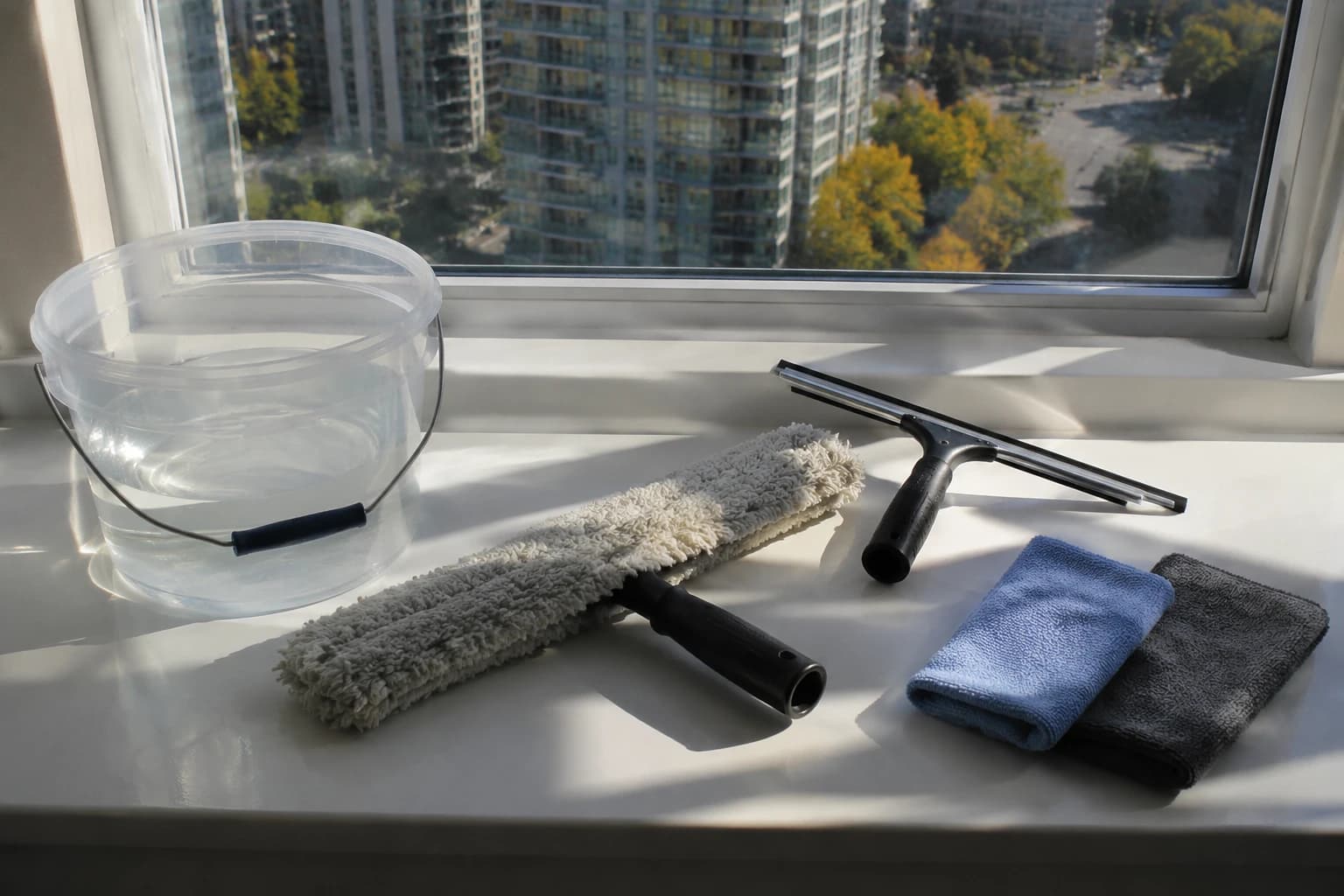
A working window cleaner carries four things: a bucket of cool water with a few drops of dish soap, a T-bar with a washing sleeve, a squeegee with a fresh rubber blade, and lint-free cloths. That is the whole glass-washing system. There is no proprietary formula, and anyone selling you one is selling you the least important variable in the job.
The soap is worth explaining because almost everyone misunderstands its role. It is not the cleaning agent. It is a lubricant. A dry blade on dry glass judders and skips; a trace of surfactant lets the rubber glide in one smooth pass and lifts light body oil and road film along the way. Once you understand it as lubrication rather than detergency, the correct dose becomes obvious, and the correct dose is a few drops, not a squeeze.
The blade decides your result. Squeegee rubber is consumable. It picks up nicks from window frames and grit, and a single nick leaves a hairline of water on every pass afterwards. Professionals flip or replace rubber constantly. If you have owned the same squeegee for three years and never changed the blade, that is your streak, and a replacement blade costs a few dollars.
For anything above the ground floor, the trade uses a different approach entirely: pure water fed through a telescopic pole. Tap water is pushed through sediment and carbon filtration, a reverse osmosis membrane, and a deionisation stage until a meter reads zero dissolved solids, then applied through a brush head on a carbon fibre pole. Because the water carries nothing, the glass dries spot-free with no squeegee and no ladder. There is a quiet local advantage too. Our inlet water carries so little dissolved solid that deionisation resin lasts far longer here than in a hard-water city. That is part of why pure-water work stays practical at residential prices.
Two adjacent jobs use a different kit. Mirrors, shower glass and small interior panes come up faster with a cloth and a buff than with a squeegee, which we walk through in our guide to cleaning glass and mirrors streak-free. And if you are tempted to mix something stronger than dish soap, read homemade cleaning solutions that actually work first, because several of the popular recipes quietly damage the surfaces around the glass.
- Bucket of cool water plus three to five drops of liquid dish soap. Cool, not hot: hot water evaporates faster and works against you.
- T-bar handle with a microfibre or synthetic washing sleeve. A sponge holds too little water and pushes grit around.
- Squeegee with a replaceable rubber blade, sized close to the pane width so you can cross most windows in one pull.
- Two lint-free cloths: one kept bone dry for the blade, one slightly damp for frames and sills.
- A plastic scraper for paint flecks and hardened bug residue, held flat against wet glass. Never on tinted or coated panes.
- A dry brush or vacuum crevice tool for the track, which is done before any water goes near the window.
Pro Tip
Keep two cloths and never let them meet. One is your blade cloth and it stays perfectly dry all day; the other handles frames, sills and drips. The moment you wipe the blade on a damp cloth you have reintroduced water to the one surface that must stay dry, and the next pass will streak.
What Vancouver does to glass that a national guide will not tell you
Soft water, heavy rain, conifer debris and a very low winter sun combine into a soiling pattern that is specific to this coast, and it dictates when you should clean.
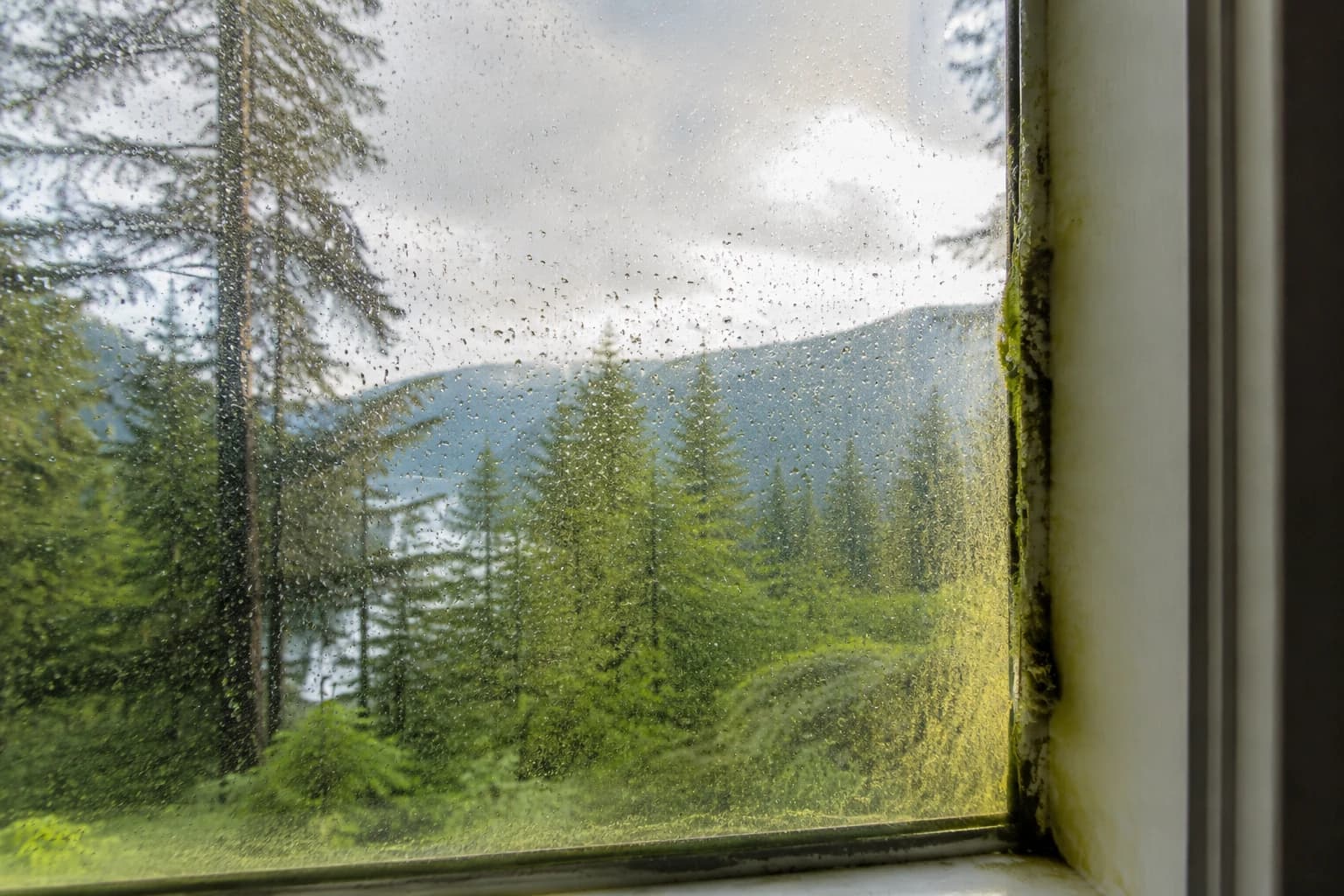
Since minerals are largely off the table here, what is actually dirtying Vancouver windows? Rain, mostly, and what the rain carries. Vancouver International Airport averages roughly 1,189 mm of precipitation a year under Environment and Climate Change Canada's 1991 to 2020 climate normals, spread across more than 160 days. Rain itself is close to distilled, but it arrives having picked up road film, brake dust and airborne grit, and it deposits that load on the glass as it sheets down and dries.
Then there is the vegetation. Conifer pollen in late spring leaves a fine yellow film that bonds surprisingly well, and cedar and fir drop sap and needle debris onto sills and tracks. Shaded lots are the harder case, and there are a great many of them in North Vancouver, Deep Cove and the older tree-covered streets of the North Shore. On those, algae and moss establish on the north and east faces of the frames and creep onto the edge of the glass. That is an organic soil, not a mineral one, which is why a soapy sleeve and a blade handle it and a fancy spray does not.
The seasonal detail is the one most people miss. At Vancouver's latitude the sun climbs to only about 17 degrees above the horizon at noon in late December. That low, raking angle strikes glass almost side-on and lights up every film, smear and drip that was invisible under a high July sun. Windows do not get dirtier in winter so much as winter starts telling the truth about them. It is also why September is the right month to do this if you are hiring it out: you get the last reliably dry stretch, and you get ahead of the light that will expose whatever you missed. The summer restriction period runs into mid-October, so a do-it-yourself exterior wash means checking the current stage first, or waiting until it lifts.
There is one more local factor, and it is a regulatory one. Metro Vancouver's drinking water conservation plan limits washing impermeable surfaces through the summer, and it counts exterior glass as one. It then exempts aesthetic cleaning done by a commercial cleaning operation, and it names window cleaning inside that exemption. Read plainly: the rules are written so that hired window cleaners keep working through the season under the stages where the exemption applies. The active stage moves through the summer, so check the current restrictions before you plan an exterior wash yourself.
- Late spring: conifer pollen film, worst on south and west faces.
- Summer: irrigation overspray is a leading source of the genuine hard-water spotting you do see on residential glass here. Adjust the sprinkler before you clean the window.
- Autumn: the last dependable dry window for exterior work, and the point where the sun angle starts exposing film.
- Winter: condensation on cold glass, plus a 17 degree sun that shows every streak. Interior work is the sensible focus.
- Shaded North Shore lots: algae and moss on frames and glass edges year round, which needs the frame cleaned as well as the pane.
Pro Tip
Walk the outside of the house before you fill the bucket and look at where the sprinkler heads are pointing. Overspray soaking the same pane every morning and evening is one of the few things on a typical Vancouver property that etches glass rather than just soiling it, and it will beat you back to that window every week until the head is turned. Two minutes with a sprinkler saves a restoration job later.
How to clean high windows, and the point where DIY should stop
There is a defensible line here rather than a vague warning, and BC's own workplace safety standard is a good place to draw it.
WorkSafeBC's fall protection regulation requires a fall protection system wherever a worker could fall 3 metres or more, or from a lesser height where the fall carries a greater risk of injury. That is an obligation on employers, not on homeowners, so nobody is breaking a rule by carrying a ladder into their own garden. But it is the standard our crews work to, and it is a reasonable line for anyone to borrow. Three metres is roughly where a second-storey window sits. Above that height, a professional is required by law to be tied off or working from the ground, which tells you something about the risk you would be accepting with a ladder and a bucket in one hand.
The practical alternative is the water-fed pole, and it is the reason most modern residential exterior work happens with both feet on the lawn. Our pole systems reach up to four storeys from the ground, which covers the overwhelming majority of detached homes and low-rise buildings in the region without a ladder ever coming off the van.
Condo and apartment residents have a simpler answer than they expect. In most mid-rise and high-rise buildings in Downtown Vancouver and Yaletown, the exterior faces are cleaned on a building-wide schedule arranged by the strata, using swing stages or bosun's chairs and specialist high-rise crews. That is not a service a resident books individually, and it is not something to attempt from a balcony or a window opening. Your side of the job is the interior glass, the tracks and the frames, plus whatever is reachable while standing flat on the balcony floor. Do not extend that reach with a pole: leaning one over a rail carries your weight toward the edge, which is precisely the risk the building's own contract exists to remove.
On a house, where you are working from ground level rather than a raised floor, the DIY equivalent of the trade's water-fed pole is a telescopic pole with a combination washer-and-squeegee head, worked from the lawn after you have looked up and confirmed there is no service drop or overhead line anywhere the pole can reach. You cannot wipe the blade between passes at that reach, so the finish will not match hand work, but long, slow, well-overlapped vertical strokes and a little residue at the edges beat standing on a ladder with a bucket in one hand.
If you do work a ladder on a ground-to-second-storey window, the non-negotiables are boring and they are not optional. Level footing, on soil the rain has not softened. A second person at the base. Three points of contact at all times. Both hands free, which means the bucket hangs off the ladder rather than travelling up in your grip. If any one of those is not true on the day, that window can wait.
- Ground floor, standing on flat ground: straightforward DIY.
- Second storey from inside, on tilt-and-turn or hinged sashes that open inward: usually DIY, and much safer than the outside approach.
- Second storey from outside on a ladder: possible, but this is the 3 metre zone. Get a spotter or use an extension pole from the ground.
- Third storey and above on a detached home: water-fed pole work, which is a professional job.
- Any high-rise or mid-rise exterior face: strata-arranged specialist crews only. Never from a balcony or a window opening.
Pro Tip
Before you buy a ladder for the job, try a telescopic extension pole with a squeegee head from ground level. You will not match a hands-on finish, but on a two-storey face it gets you most of the way there at zero fall risk, and it costs less than a decent ladder.

How much does window cleaning cost in Vancouver?
Real local numbers, what moves them, and a straight read on when paying for it makes sense.
Most residential window cleaning jobs in Metro Vancouver land between $150 and $400. That is our published range and it holds for the large majority of homes we quote, from a compact East Vancouver bungalow at the low end to a four-bedroom detached home with a lot of glass at the upper end.
What moves the number is rarely what people assume. It is not primarily the square footage of glass. It is access, pane count and condition. Twenty small divided-light panes take considerably longer than four large picture windows covering the same area, because every pane has its own perimeter to detail. Anything above the ground floor brings out different equipment. And glass that has not been touched in three years needs a scrape-and-prep pass before a squeegee is any use at all.
Interior and exterior are usually quoted together, because one visit costs meaningfully less than two and you cannot judge a finish until both sides are done. The soil divides along predictable lines here: exteriors carry the rain-borne grit, interiors carry the fingerprints.
Worth checking against any quote you get: ours includes screens removed, washed and reinstalled, plus the tracks and frames. Tracks matter more than they sound. A track packed with damp organic debris is where window mould gets its foothold, and it is the part a glass-only price leaves behind.
As for whether to hire it out at all, the honest test is not cost, it is scope and height. A ground-floor bungalow with eight windows is a pleasant Saturday morning and a starter kit you will keep using for years. A three-storey house with thirty panes is a full day, a ladder you probably do not own, and a real fall risk. Somewhere between those two the maths turns over, and it turns over on height long before it turns over on time.
- Typical Metro Vancouver residential job: $150 to $400 for interior and exterior together.
- Main cost drivers, in order: access and height, number of individual panes, condition and time since the last clean, screen and track work.
- Divided-light and heritage windows cost more per square metre of glass than large modern panes, because the perimeter work multiplies.
- First cleans after several years cost more than maintenance visits, because prep work is a separate stage before washing.
- High-rise exterior faces are not priced per household. They are a strata contract with a specialist high-rise crew.
Pro Tip
When you request a quote, count panes rather than windows and say which storeys they are on. Those two numbers determine almost the entire price, and a quote given from them is far less likely to move on the day than one based on the number of bedrooms.
How often should you clean windows in a rainy climate?
Twice a year is the realistic baseline for most Metro Vancouver homes, and the timing matters more than the frequency.
Twice a year is the baseline for most homes here, whether you do it yourself or hand it over: early spring, once the winter grime and the last of the storms have finished, and early autumn, after pollen season and before the rain sets in properly. Exposure moves that number more than house size does. A home on a busy arterial collects road film fast, a property under heavy tree cover holds damp long enough for algae to establish, and a waterfront or exposed-ridge property takes salt spray and wind-driven grit. Any of those pushes you toward three or four visits.
Between professional visits, the highest-value maintenance is not the glass at all. It is the tracks and the sills. Vacuum the tracks, wipe the sills dry, and you remove the damp organic layer that mould needs, which protects both the window and the air in the room. That habit slots neatly into our Vancouver spring cleaning checklist.
One last thing, because it comes up on nearly every quote. Rain shortly after a clean does not undo the work. Clean glass sheets water evenly and dries clear; it is dirty glass that turns rain into visible spotting, because the drops have something to bond to and leave behind. The windows you remember as spotted after a shower were dirty before it started.
Sometimes the glass is one line on a much longer list. A deep clean covers the accessible interior glass along with everything routine cleaning never reaches, and for apartments and towers our condo cleaning service is scoped to the interior glass, tracks and balcony doors that residents are responsible for. Either way the standard is the one you can now check for yourself: step to the side, let the light rake across the pane, and see what it tells you.
- Standard Metro Vancouver home: two professional cleans a year, in early spring and early autumn.
- Under tree cover, on an arterial road, or exposed to salt and wind: three to four a year.
- Interior-only visits between full cleans are good value in homes with young children or dogs.
- Vacuum tracks and dry sills monthly through the wet season. This is the single highest-return five minutes on a window.
- Do not cancel because rain is forecast for the days after. Clean glass sheets water off and dries clear. Do avoid working in the rain itself, and above all avoid direct sun, which is the thing that actually ruins a finish.
Pro Tip
Book the autumn clean for September rather than November. In September you are still getting dry, overcast working days, which are ideal conditions. By November you are fighting both the weather and a sun low enough to expose any compromise you made getting the job done.
Step-by-Step
How to clean windows step by step: the professional method
This is the sequence a working window cleaner uses on every pane. It takes about three minutes per window once it is familiar, and the order matters as much as the technique.
Dry-clean the track and frame first
Everything loose comes off before any water arrives. Wet grit in a track turns into mud that you will then spread across clean glass, which is why professionals never start with the pane.
- Vacuum the track with a crevice tool, then brush the corners out
- Dry-brush cobwebs and debris off the frame and the top edge
- Remove screens now, and set them aside to wash separately
Mix a weak solution in cool water
Three to five drops of liquid dish soap in a bucket of cool water. It should feel barely slippery, not sudsy. If you can see a head of foam, there is too much soap in it and the glass will haze as it dries.
- Cool water, not hot, so it does not flash-dry on the pane
- Three to five drops per bucket, no more
- Remake it when it turns grey rather than topping it up
Work out of direct sun
Follow the shade around the house rather than working a whole elevation at once. Sun-warmed glass dries the solution before the blade reaches it, and that dried film is the streak everyone blames on their cleaner.
- Start on the shaded side and follow the shade as it moves
- An overcast Vancouver morning is genuinely the best condition available
- In summer, do east-facing glass in the afternoon and west-facing in the morning
Wash the whole pane with the sleeve
Wet the sleeve, wring it lightly, and scrub the entire pane including hard into all four corners. This is the stage that does the cleaning; the squeegee only removes water. Give any bonded spot a fingernail or plastic scraper now rather than hoping the blade takes it.
- Cover the full pane, corners and edges included
- Work bonded residue with a plastic scraper held flat, never on tinted or coated glass
- Leave the glass genuinely wet, not damp, going into the next step
Pull the squeegee in overlapping passes, wiping the blade every time
Start at the top and pull straight down in slow passes, overlapping each one by two or three centimetres into the already-dry strip. Wipe the blade dry on your dedicated cloth after every single pass. This one habit is the difference between a home finish and a professional one.
- Hold the blade at roughly 45 degrees, not flat and not perpendicular
- Overlap each pass into the dry area beside it so there is no untouched seam
- Wipe the blade dry after every pass, without exception
- On tall glass, work top half then bottom half rather than overreaching
Detail the perimeter and the sill
Water always wicks back from the frame after you finish, which is the cloudy-edges streak. Run a dry lint-free cloth around the full perimeter and along the sill as the final action on each window, not at the end of the whole job.
- Dry cloth around all four edges where water collects
- Wipe the sill and the bottom of the frame completely dry
- Reinstall screens only once they and the frame are fully dry
Inspect from an angle, in the worst light you can find
Head-on inspection hides everything. Move to a shallow angle so light rakes across the surface, and check from inside and outside. In Vancouver, low winter light is the harshest inspector you will get, which is exactly why it is the standard worth checking against.
- Crouch or step sideways so the light reflects off the pane toward you
- Check each pane from both sides before moving on
- Touch up with a dry cloth rather than rewashing the whole window
| Situation | Best DIY approach | Where it falls short | Worth hiring out when |
|---|---|---|---|
| Ground-floor windows, modern sealed units | Sleeve, squeegee, few drops of soap, work in shade | Nothing. This is the right tool for the job | You would rather have the Saturday back |
| Second-storey exterior glass | Telescopic pole from the ground, or reach from inside on inward-opening sashes | Ladder work here is the 3 metre fall zone WorkSafeBC writes rules about | There is no safe footing, no spotter, or the ladder is not yours |
| Divided-light or heritage windows | Small squeegee or the cloth-and-buff method per pane | Time. Twenty small panes take far longer than the same area of picture window | The pane count runs past what a morning holds |
| Glass not cleaned in several years | Scrape and prep pass first, then wash normally | Bonded film and mineral deposit will not yield to soap and a blade | Deposits survive a full prep pass, or the glass looks permanently hazed |
| Third storey and above, detached home | Nothing safe from a ladder | Height. This is water-fed pole work by design | Always. Pole systems reach four storeys from the ground |
| Mid-rise or high-rise condo exterior | Nothing. Not a resident job | Exterior faces need swing stages and specialist high-rise crews | Always, and it is arranged by the strata rather than by you |
Services mentioned in this article
Ready for help?
4.9 · 850+ Google reviewsWant the glass done properly, without the ladder?
Whether it is a full interior and exterior clean before the light turns, or just the second-storey panes you would rather not climb to, our crews work from the ground with water-fed poles up to four storeys, and screens, tracks and frames come as standard. Backed by 850 reviews and our satisfaction guarantee.
778-720-2224Window cleaning: common questions
What is the best way to clean windows without streaks?
Use a soapy sleeve to wash the glass first, then take the water off with a squeegee held at about 45 degrees, overlapping each pass into the strip you have already dried. Wipe the blade on a dry lint-free cloth between passes and work out of direct sun. Finish by running that cloth around the frame edge, where water wicks back and leaves a cloudy border.
What do professional window cleaners use in their water?
For hand work, a few drops of liquid dish soap in cool water. The soap is a lubricant for the squeegee blade rather than the cleaning agent. For work above the ground floor, professionals use purified water instead, pushed through reverse osmosis and deionisation until it carries no dissolved solids, then applied through a brush on a telescopic pole. Water that pure dries without spotting and needs no squeegee.
Why do my windows still streak after I clean them?
Almost always one of three things: too much soap, a wet or nicked squeegee blade, or glass that dried in the sun before you finished. In Metro Vancouver it is very unlikely to be your water. Treated water here measured between 2.5 and 22.4 mg/L hardness in 2024, far below the level at which water is called hard, so mineral spotting from the tap is rarely the culprit.
How much does professional window cleaning cost in Vancouver?
Most residential jobs in Metro Vancouver run $150 to $400 for interior and exterior together. Price is driven by access and height, the number of individual panes rather than total glass area, and how long it has been since the last clean. A wall of twenty small divided-light panes prices higher than four picture windows of the same area, because each one has its own perimeter to detail.
How often should you clean your windows in a rainy climate?
Two professional cleans a year suits most Metro Vancouver homes, in early spring and early autumn. Push to three or four if you are under tree cover, on a busy road, or exposed to salt and wind. A shower the next day will not spoil the finish either: only dirty glass leaves visible spots, because the droplets need grit to cling to.
Can I clean my own second-storey windows?
From inside, yes, especially on sashes that open inward. From outside on a ladder, be careful about what you are taking on. WorkSafeBC requires fall protection for workers wherever a fall of 3 metres or more is possible, which is roughly second-storey height. A telescopic pole from the ground is the safer route, and above the second storey it is genuinely a job for water-fed pole equipment.
What is the best solution to clean windows with?
Three to five drops of liquid dish soap in a bucket of cool water. That is it, and in Metro Vancouver you do not need distilled water because the tap water is already soft. Skip vinegar on exterior glass, since it does little for road film and can mark aluminium frames, and skip ammonia entirely on tinted or coated panes. If the glass still hazes, the fix is less soap, not a different bottle.
Sources & References
The facts in this guide come from the primary sources below. Links open in a new tab.
- 1Greater Vancouver Water District 2024 Water Quality Annual Report, Volume 1Metro Vancouver
- 2Drinking water conservation plan and current water restrictionsMetro Vancouver
- 3OHS Guidelines Part 11: Fall ProtectionWorkSafeBC
- 4Canadian Climate Normals 1991-2020, Vancouver International Airport (station 51442)Environment and Climate Change Canada

Meet the Author
Pamela
Co-Founder
Pamela leads residential quality standards at P&J Cleaners, refining safe, detail-driven cleaning systems for Vancouver homes, condos, and move-out projects.
Keep Exploring