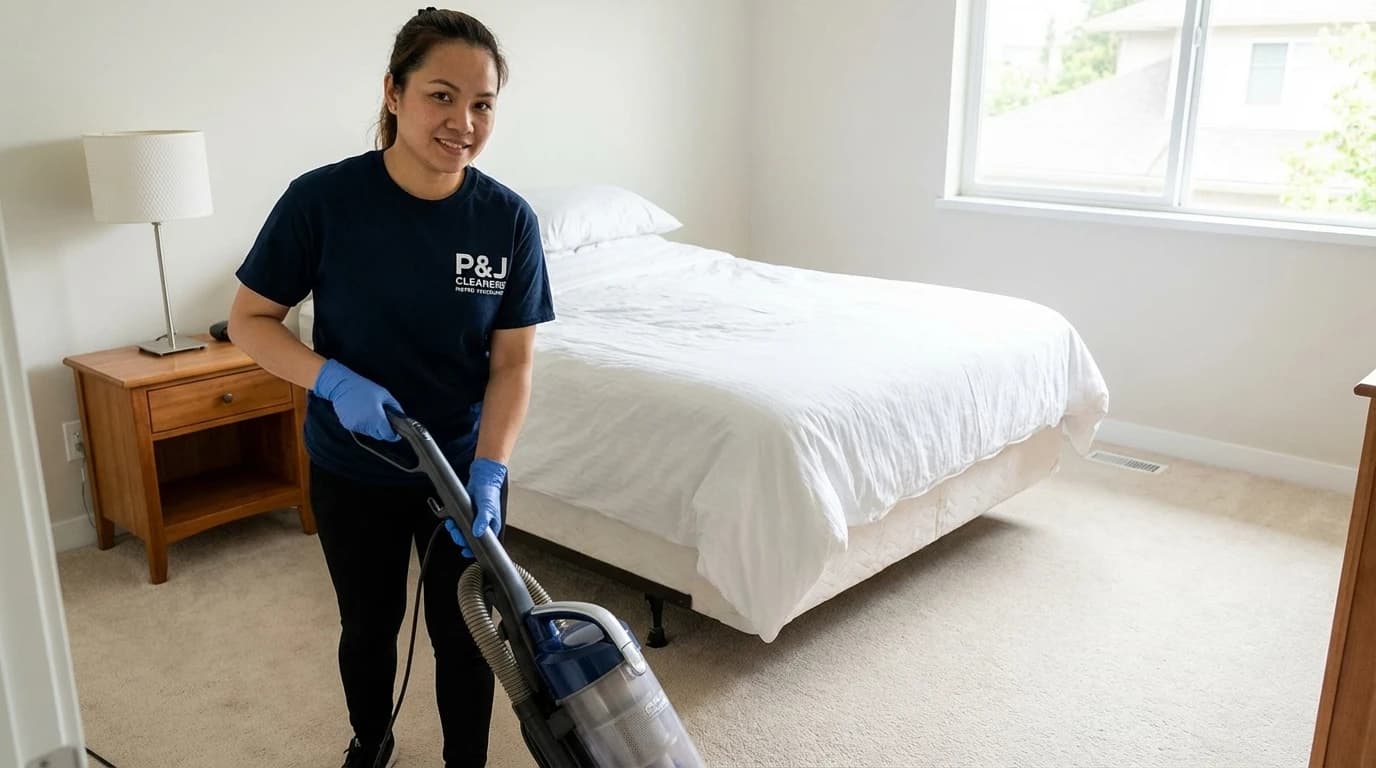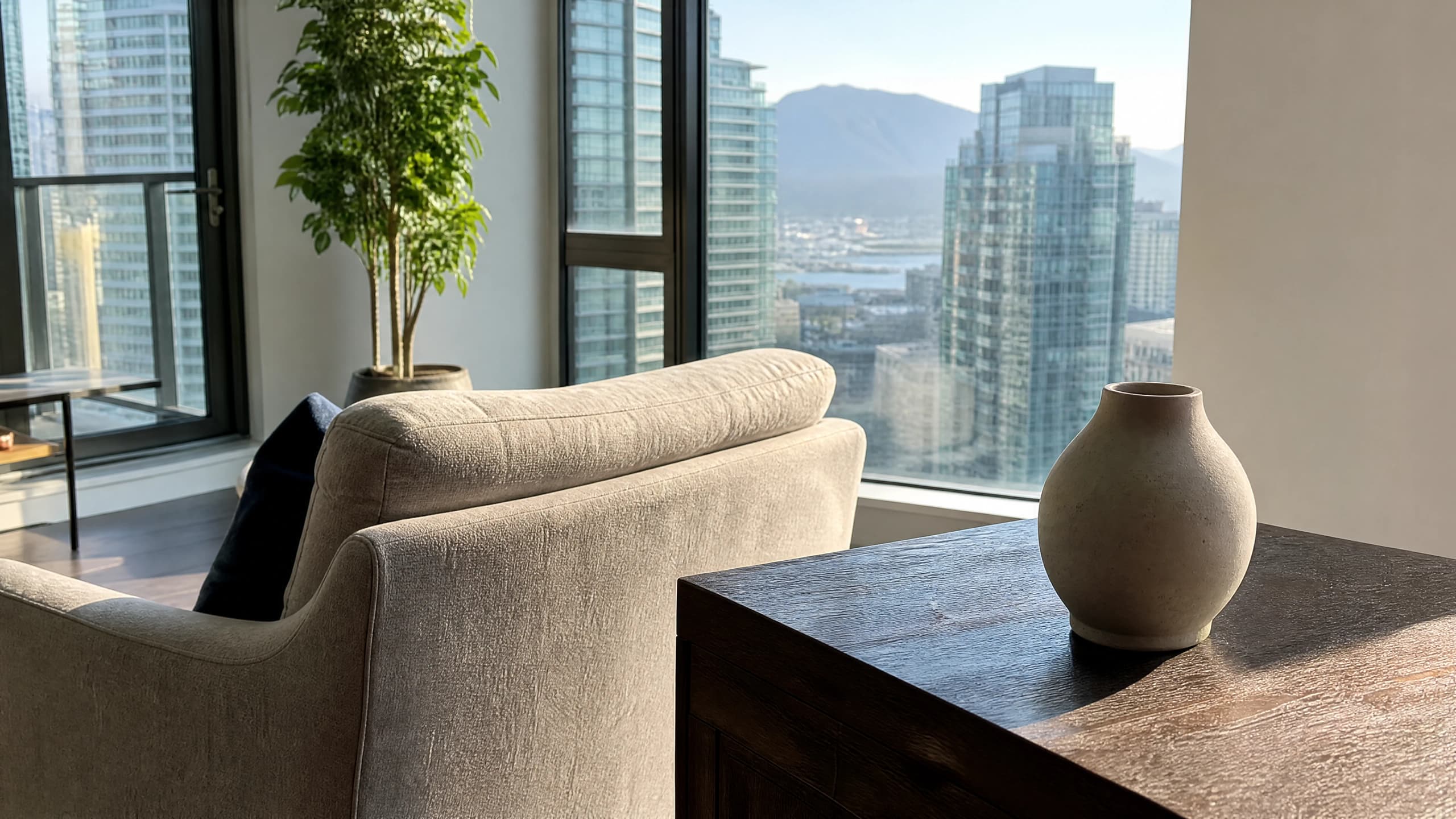


Quick answer
Why is my apartment so dusty? Because most of the air reaching a Vancouver condo suite arrives through corridors, elevator shafts and leaky wall cavities rather than through a filter. Sealed windows, wildfire smoke, nearby tower construction and shedding textiles finish the job, which is why a suite can look dusty again three days after a clean.

Key Takeaways
- 1In a 13-storey Vancouver apartment building, only about 37 percent of the air the rooftop make-up air unit pulled in actually reached the corridors. The rest leaked out of the duct on the way.
- 2Only about 20 percent of a pressurized corridor's airflow paths lead directly into suites. The other 80 percent lead into stairwells, elevator shafts and other shared spaces.
- 3About 69 percent of stack-effect pressure in a measured 13-storey Vancouver tower acted across suite entrance doors rather than the exterior wall, which makes your hallway door a bigger air leak than your window.
- 4Running a bathroom fan or range hood depressurizes your suite and pulls unfiltered corridor air in under the front door.
- 5Wildfire-smoke guidance puts the filter threshold at MERV 13 or higher for fine smoke particles, which may be more than your fan coil unit is built to take, so check what yours is rated for before upgrading.
- 6In the measured Vancouver tower, upper floors were over-ventilated and lower floors under-ventilated, so check your floor and your distance from the elevator core before you blame your own cleaning.
- 7Dust settles from the top down, so anything you clean before the high surfaces gets re-dusted the moment you touch them.
What Condo Dust Is Actually Made Of
Most of the grey film on your shelf did not blow in off the street. It is a mix of what your home sheds and what the building delivers.
Household dust is part what your home sheds and part what arrives from outside it. The homegrown side is skin cells, hair, textile fibres shed by bedding, towels, upholstery and clothing, paper fibre from books and mail, and pet dander if you have an animal. The imported side is soil and grit tracked in on shoes, pollen, combustion particles from traffic, and the fine grey powder thrown off by whatever is being built nearby.
That split matters because it tells you which lever to pull. Fibre and skin, the kind that clings and looks fluffy, means the fix is textiles and vacuuming. Fine grey dust that lands evenly everywhere, including the vertical faces of picture frames and the sides of lampshades, means the fix is air. In a condo it is usually air, and the reason is structural.
One quick test: run a finger across a dark surface near the front door, then the same surface at the far end of the suite. If the door end is consistently dirtier, you are looking at an air-path problem, not a housekeeping problem.
- Fibre-heavy dust that clings and looks fluffy points at bedding, towels, throws and upholstery.
- Fine, even, grey dust that reappears within days points at outdoor air or the corridor.
- Gritty dust near the entry points at shoes and the hallway carpet outside your door.
- Dark, greasy film in the kitchen is cooking aerosol, not dust, and needs degreaser rather than a duster.
Pro Tip
Tape a strip of clear packing tape across the inside face of the vent grille nearest your door and pull it off after a week. What comes with it tells you what is arriving: grey powder is building and outdoor air, fluff is textile fibre from inside the suite, and gritty black specks are usually brake dust off the street or out of the parkade.
Why Is My Apartment So Dusty When a House Isn't?
In a Vancouver tower the fresh air your suite is designed to receive can largely fail to arrive, so the suite makes up the difference through paths nobody filters.
A detached house pulls most of its air in through its own walls and its own furnace filter, so it is mostly breathing its own street. A condo suite is not. Corridor pressurization is pervasively used to ventilate mid- and high-rise multi-unit residential buildings across North America. A make-up air unit on the roof pushes fresh air down a shaft into the hallways, the hallways sit at a slightly higher pressure than the suites, and that pressure difference is supposed to push clean air under your front door and out through your suite. It is elegant on paper. It works poorly in practice, and there is Vancouver-specific data to prove it.
Building science firm RDH instrumented a 13-storey Vancouver apartment building from 1986 with 37 units and measured the whole path. Their ASHRAE study of corridor pressurization performance found that only about 37 percent of the air the rooftop unit pulled in actually made it into the corridors. The rest leaked out of the ductwork before it got there.
Then it gets worse. Airtightness testing showed that when a corridor is pressurized, only about 20 percent of the available airflow paths lead directly into the adjacent suites through the entrance doors. The other 80 percent lead into stairwells, elevator shafts and other shared spaces. Two separate findings, measuring two different things: how much of the intake volume reaches the corridor, and where the corridor's leakage paths point.
Your suite still needs to replace the air it loses. If the designed supply is not delivering, the air comes from wherever the pressure lets it: the corridor, the elevator lobby, the wall and floor cavities, the gap around a plumbing stack, the shaft your neighbour's fan vents into. None of those paths has a filter on it. That is the single biggest reason a condo dusts up faster than a detached house, and it is the thing no national dusting guide mentions.
- Designed path: rooftop unit to shaft to corridor to under your door to your suite to outside.
- Actual path in the measured building: only about 37 percent of the intake air reached the corridors, and only about 20 percent of the corridor's airflow paths pointed into suites at all.
- Replacement path: unfiltered leakage through corridors, cavities and shared shafts.
- Consequence: your suite is breathing a slice of the whole building, including everyone's cooking, corridor carpet fibre and parkade air.
Pro Tip
This is also why a suite can smell faintly of a neighbour's dinner. Odour and dust travel the same leakage paths, so a persistent transferred smell is a reliable clue that your suite is drawing air from the building rather than from outdoors, and a stale suite that never quite clears is usually the same story told through your nose. Our [musty smell guide](/blog/get-rid-of-musty-smell-apartment) picks that thread up.
Your Front Door Leaks More Than Your Window
Stack effect drives air through a tall building, and in the Vancouver study most of that pressure landed on suite entrance doors rather than the exterior wall.
Stack effect is the reason tall buildings breathe. Warm indoor air is less dense than cold outdoor air, so it rises through the building and pushes out near the top while outdoor air is drawn in near the bottom. The height at which the two pressures balance is called the neutral pressure level. The National Research Council of Canada has documented the mechanism for decades: the taller the building and the bigger the indoor-to-outdoor temperature difference, the harder it pushes.
You would expect that pressure to act on the outside wall. In the Vancouver building it mostly did not. Roughly 69 percent of the theoretical stack-effect pressure difference was measured across the suite entrance doors instead. The exterior walls and windows in that building were tight enough, and the hallway doors leaky enough, that the hallway door became the path of least resistance.
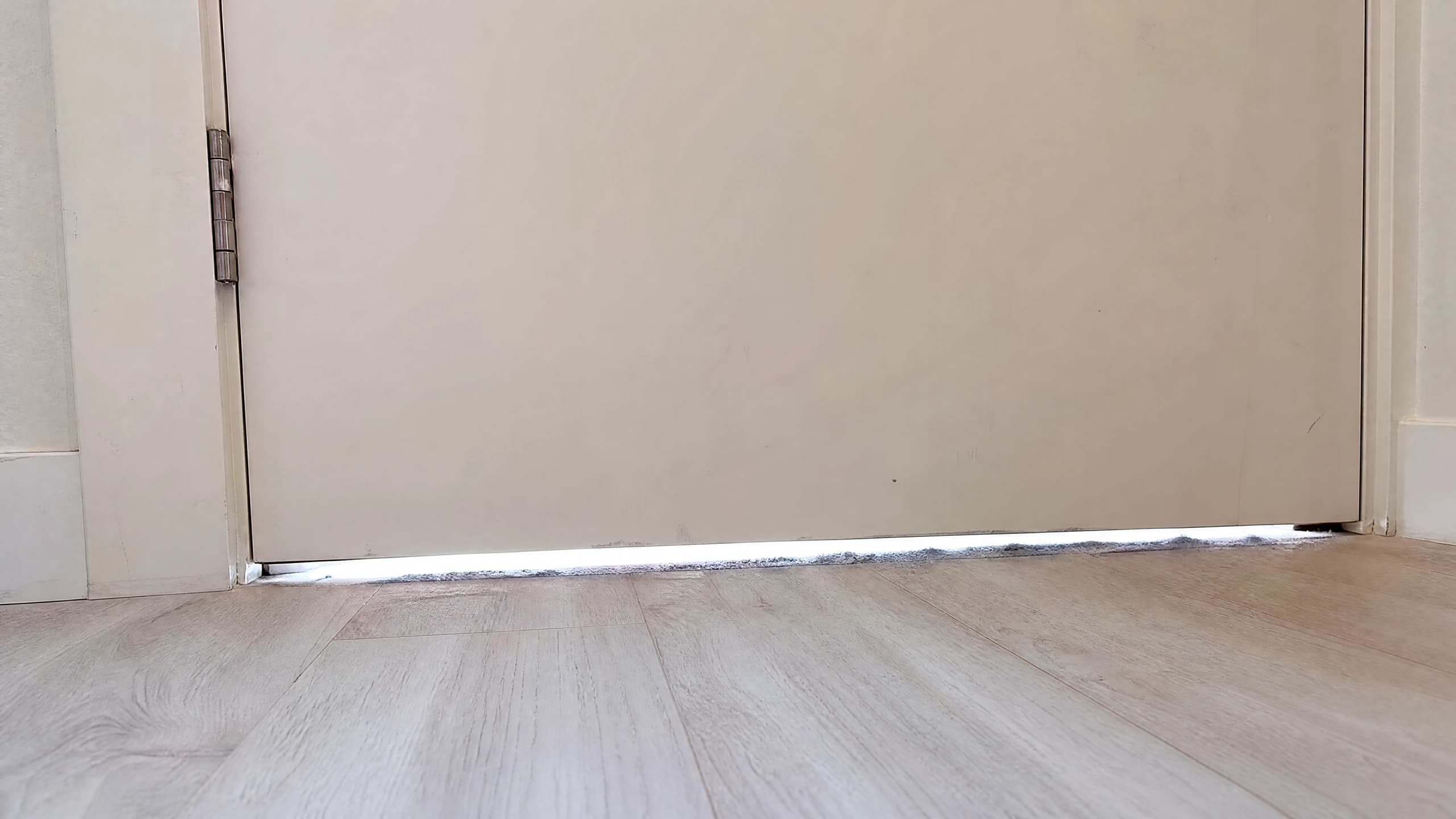
So the gap under your front door, the one you step over every day without thinking about it, is doing more air exchange than the window you keep closed. On a cold January morning, with the suite far warmer than the air outside, that gap is a working vent pulling corridor air across your floor.
The study also confirmed something you can test yourself in thirty seconds. Running an in-suite exhaust fan depressurizes your unit relative to the corridor, which increases the pressure difference across your front door and pulls more hallway air in. Every long shower with the fan running, and every hour the range hood stays on after dinner, is an hour of unfiltered corridor air being drawn under the door.
- Hold a tissue at the bottom of your closed suite door. If it pulls toward you, corridor air is coming in.
- Repeat the test with the bathroom fan running. The pull almost always gets stronger.
- A brush-style door sweep or draft stopper on the suite door is the cheapest meaningful dust intervention in a condo.
- Do not seal the door airtight. Your suite needs a make-up path, and starving it can pull air from worse places such as the parkade or a garbage chute.
Pro Tip
Most suite bathroom fans are wired straight to the light switch, so they run for the whole shower and then get forgotten for the evening. An inexpensive countdown timer switch fixes it permanently: press twenty minutes, walk away, and your front door stops working as a corridor intake for the rest of the night.
Four Dust Sources That Are Specific to Metro Vancouver
The mechanism above is general to Canadian towers. What loads the air on the outside of the building is local.
Wildfire smoke is the big one. Metro Vancouver now gets recurring summer smoke episodes, and the Province's air quality warnings tell residents to keep windows and doors closed and to run a good quality filter in the ventilation system or a certified portable air cleaner. Smoke particles are far smaller than household dust, so they slip through a basic filter, then settle out as an ultra-fine film that reappears within a day of wiping. If a heavy smoke episode has already coated the suite, our wildfire smoke cleanup guide covers the recovery pass.
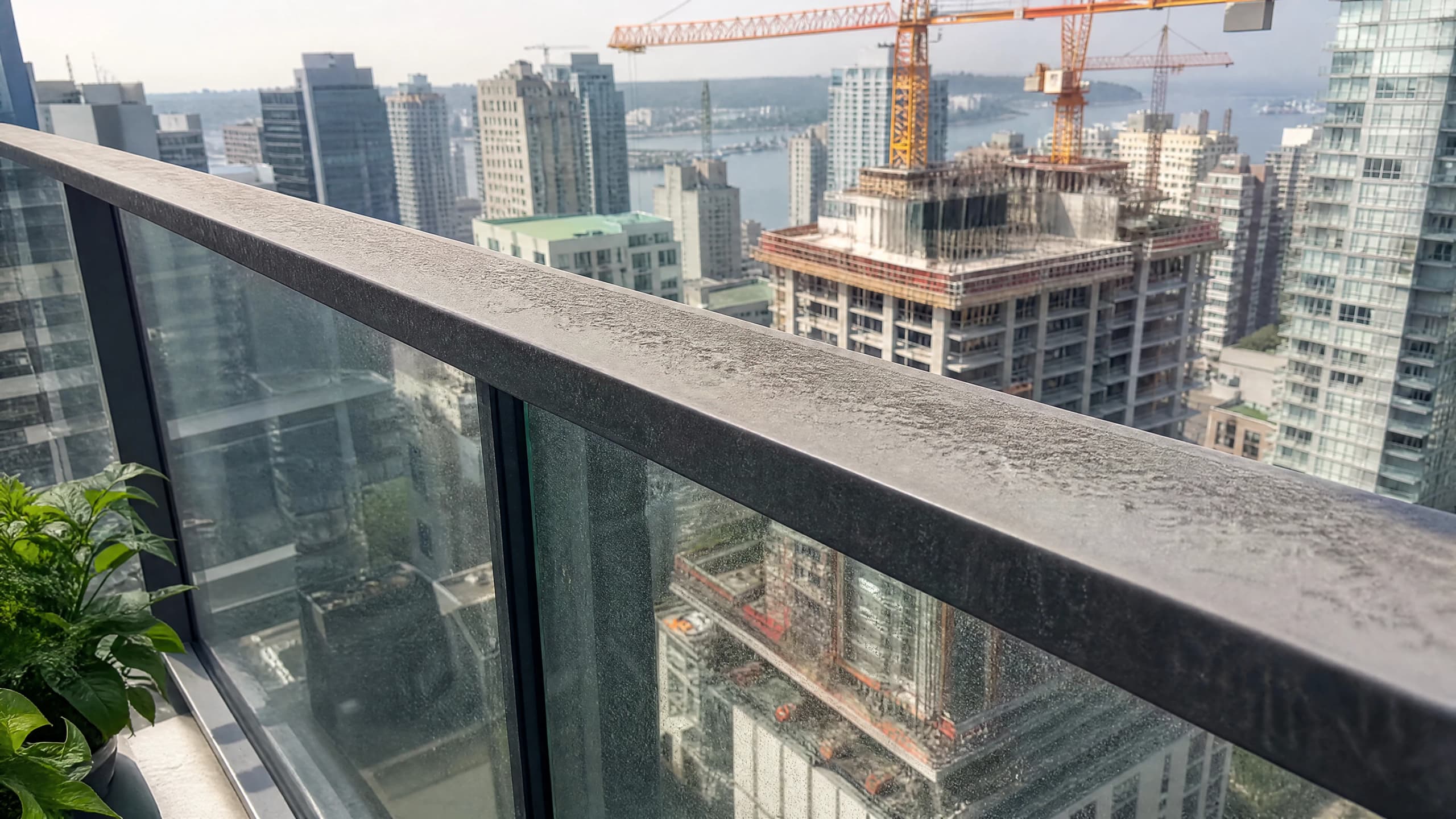
Then there is whatever is being built next to you. Anywhere along the Cambie corridor, around Brentwood, or in the Metrotown blocks, there is excavation, concrete cutting and drywall work happening upwind of existing towers, throwing off a fine grey powder. That powder is dry, light and travels further than people expect, and it is what turns a balcony rail grey in a week.
Spring adds pollen, and Metro Vancouver's tree pollen season runs longer than most people expect. Alder and birch run from roughly mid-March into early June, well before the grass pollen that most people think of as allergy season. If your dust problem has a spring spike and comes with itchy eyes, that is the calendar telling you the source.
Last is the least dramatic and the most persistent: our long, mild, wet heating season. Vancouver winters are not cold enough to feel dramatic, but they are long enough that windows stay shut for months at a time. A long stretch of low ventilation means whatever gets in has nowhere to go, and it recirculates until it lands on something.
- Smoke season: late summer, windows shut, fine particles that basic filters miss.
- Construction: check what has active hoarding within two or three blocks upwind of your balcony.
- Pollen: mid-March to early June for alder and birch.
- Heating season: a long wet winter with minimal window ventilation and maximum recirculation.
Pro Tip
During a smoke advisory, resist the urge to air the place out the moment the sky clears. Fine particles hang around after visibility recovers. Wait for the advisory itself to be lifted, then open up on a breezy day.
The In-Suite Culprits People Miss
Once the building's contribution is handled, four things inside the suite account for most of what is left.
Your fan coil filter is the one nobody thinks about. Most condo suites have a fan coil unit in a closet or above the entry hall with a filter in it, and in a rental it is common to find the original one still in place years later. Check it. If it is grey and matted, it stopped filtering a long time ago and started restricting airflow instead.
Do not jump straight to the highest MERV number on the shelf. Fan coil units are built around a thin, low-resistance filter. Put something much denser in front of that small fan and you raise the pressure it has to push against, which cuts airflow and makes the unit whine. Wildfire-smoke guidance for Canadian homes puts the threshold at MERV 13 or higher for the fine particles in smoke, so if smoke is your problem, ask your building manager or an HVAC tech what your unit can actually take. In most suites the practical answer is the highest rating your unit is built for, kept genuinely clean, plus a standalone air cleaner in the room you sleep in.
Textiles are the second. Every bed, throw, cushion and curtain is a fibre reservoir that sheds continuously and releases a puff of dust every time someone sits down. Washing bedding weekly in hot water and running curtains through a wash once a season does more for visible dust than any spray product.
Third is your entryway. Shoes carry in grit, brake dust and whatever is ground into the corridor carpet outside your door, and condo entries are usually too cramped for a mat big enough to take any of it off, so most people skip the mat entirely. Grit needs several steps to come off. A large flat mat inside the door does more than any decorative one outside it.
Fourth is the dryer, which nobody suspects. A lint trap that gets a quick pull-off rather than a proper clean, or a vent hose that has worked loose behind the machine, puts a fine load of fabric fibre back into the room every cycle. Pull the trap right out, wipe the slot it sits in, and check the hose behind the dryer is still clamped.
- Locate your fan coil filter, note the size, and set a calendar reminder to check it every three months.
- A large flat mat inside the door beats a small decorative one outside it. Grit needs several steps to come off.
- Wash bedding weekly and curtains seasonally. Vacuum upholstery with the brush tool while you are there.
- Clean the lint trap fully every load and wipe the housing it sits in monthly.
- Vacuum with a sealed HEPA machine. A vacuum that leaks fines out the back is an efficient dust redistributor.
Pro Tip
Photograph your fan coil filter's size and model the first time you pull it, and keep the photo in your phone. The single most common reason people skip the change is standing in a hardware aisle not knowing which one to buy.
What Actually Reduces Dust, in Order of Payoff
Order matters more than product choice. Doing the right things in the wrong sequence means doing them twice.
Start with the air paths, because they change the rate dust arrives rather than how much of it you remove. A door sweep on the suite entrance, disciplined use of the exhaust fans, a genuinely clean fan coil filter and a mat inside the door will cut what lands on your surfaces before you buy a single cleaning product.
Then fix the method. Dry dusting with a cloth or a feather duster lifts fine particles into the air, where they stay suspended for hours and then land back on everything you just did. Damp microfibre traps and holds them. Slightly damp, folded into quarters so you have eight clean faces, rinsed when it stops gliding.
Then fix the order. Dust falls. Work top to bottom in every room: light fixtures and door frame tops, then shelves and picture frames, then furniture surfaces, then baseboards, then vacuum the floor last. If you vacuum first and dust after, you have just seeded the carpet you cleaned.
A portable air cleaner is worth it for the room you sleep in, particularly during smoke season. Size it to the room rather than buying the biggest unit on the shelf. And be clear about what it does: it filters the air passing through it, so airborne particle counts drop. It will not touch the dust already sitting on your blinds or behind the sofa. That part is still a cleaning job.
- Fit a brush door sweep on the suite entrance and put a large flat mat inside it.
- Run the exhaust fans only while they are doing something.
- Check the fan coil filter quarterly, and change it once it looks grey.
- Dust with damp microfibre. Never dry cloths, never feather dusters.
- Work top to bottom in every room and vacuum last, with a sealed HEPA machine.
- Wash bedding weekly, curtains and upholstery seasonally.
- Put a room-sized air cleaner in the bedroom for smoke and pollen season.
Pro Tip
Wipe the vent grille faces and the top of every door frame on the same day you change the filter. Those two surfaces reload the room continuously and almost nobody includes them in a weekly clean, which is exactly why a room can look dusty again three days later.
When a Deep Clean Is Worth Booking, and What It Will Not Fix
A reset clears the reservoirs your weekly routine cannot reach. It does not change the building's air paths, and it is not duct work.
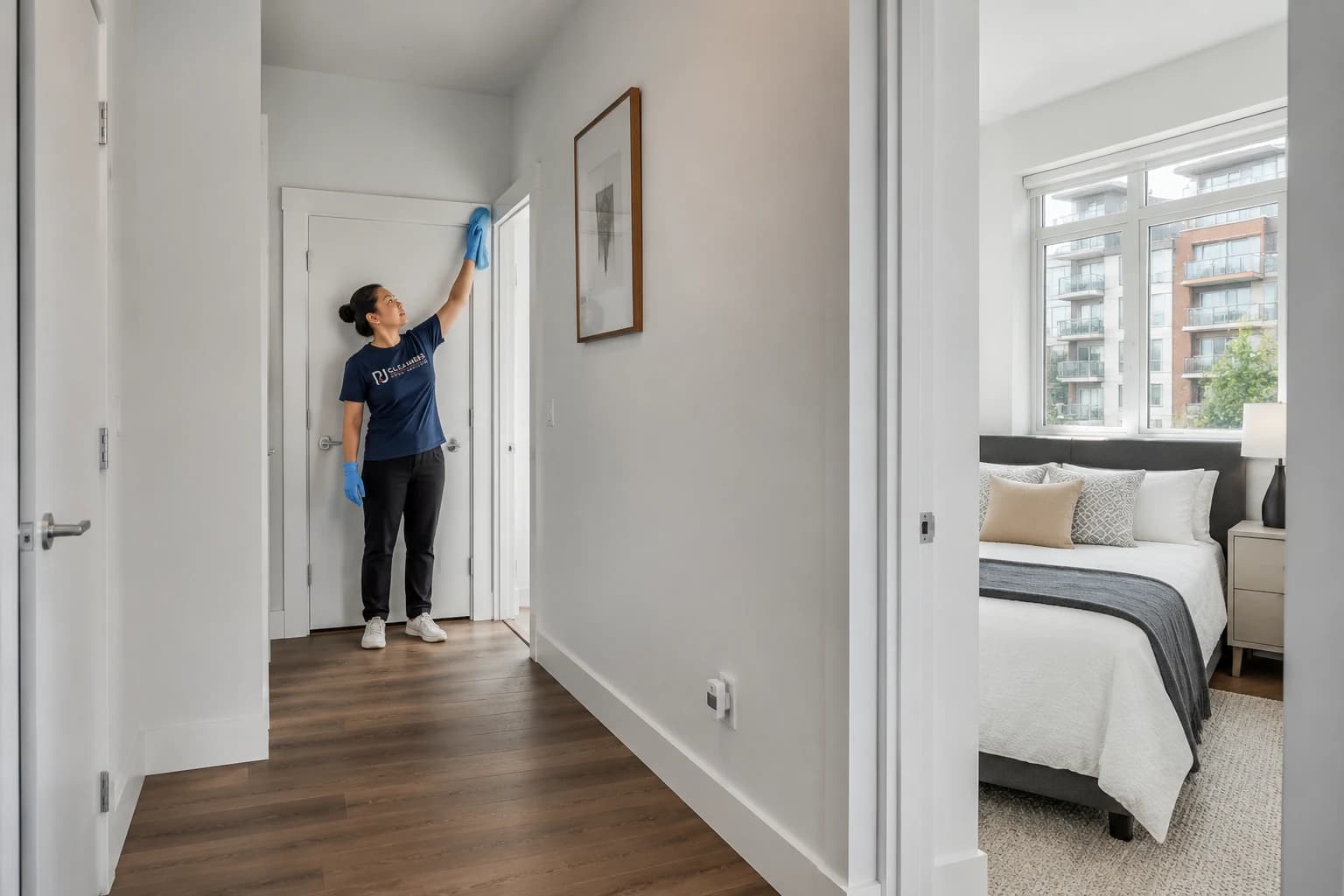
There is a point where frequency stops helping. If you are wiping twice a week and the room still looks dull, the dust is not on the surfaces you keep wiping. It is in the places a weekly routine never goes: the tops of upper cabinets, blind slats, behind and under the appliances, baseboards and trim, vent grille faces, light fixtures, and the strip of floor beneath furniture that has not moved in a year. Those act as reservoirs. Every time the air moves, they release a little more back into the room.
That is the specific job a deep clean does well: it empties the reservoirs so your weekly wipe-down has a chance of holding. In a condo it is usually worth doing once or twice a year, plus after any renovation in the building, and it is the usual starting point when someone new to a suite inherits several years of somebody else's dust. After that, keeping it there is much cheaper than getting it there, which is the whole argument for a regular condo cleaning visit rather than another reset next year.
Be clear about the boundary, though. A deep clean will not change your building's ventilation, will not seal your suite door, and will not clean inside the ductwork. Duct cleaning is a separate trade with different equipment and different access requirements, and it is not part of a residential deep clean. If your building's shared system is genuinely the problem, that is a conversation for your strata council or building manager, not for a cleaning company.
Our teams work in towers across downtown Vancouver, Yaletown and Brentwood every week, so the pattern in this article is not theoretical. High-floor units near an elevator core with an unsealed suite door and a filter nobody has changed are consistently the dustiest suites we walk into, and they are also the ones that improve the most once the reservoirs are cleared and the door gets a sweep. If that high-reach reset is not something you want to do yourself, it is what our apartment cleaning visits are built around. And if the dust comes with itchy eyes and a stuffy nose, the culprit is usually dander and dust mites rather than building air, which our allergen reduction guide covers properly.
- Book a reset if you are cleaning weekly and still re-dusting within three days.
- Book after construction anywhere in your building, not just in your own suite.
- Book when moving into a suite you did not previously live in.
- Handle the door sweep, the filter and the mat yourself. They are cheap, and they hold the result.
Pro Tip
If your building has posted notice of upcoming work on the exterior, the elevators or the parkade, book the reset for after it finishes rather than before. Site dust migrates through the same shafts your suite draws air from, and cleaning ahead of the work means paying for it twice.
Step-by-Step
How to Find Your Condo's Actual Dust Source in One Week
Generic dusting tips fail because they treat every apartment the same. This is a cheap diagnostic that tells you which of the causes above is yours before you spend anything.
Set two paper markers
Place a square of clean white paper on top of a door frame near your suite entrance and another on a shelf at the far end of the home. Leave them a full week.
- Use plain white paper so fine grey dust is visible
- Note the date on each one in pencil
- Do not clean either surface during the week
Do the tissue test at your front door
Hold a single tissue against the bottom of your closed suite entrance door, first with everything off, then with the bathroom fan running.
- Tissue pulling inward means corridor air is entering
- A stronger pull with the fan on confirms the suite is depressurized
- Repeat at the balcony door for comparison
Pull and photograph your fan coil filter
Find the fan coil closet, slide the filter out, and photograph both faces and the size printed on the frame.
- Grey and matted means it stopped working some time ago
- Record the exact dimensions so replacements are easy to buy
- Ask your building manager what MERV rating your unit is rated for
Check what is happening outside
Look for active construction hoarding within a few blocks, and check whether an air quality advisory is in effect for your area.
- Note which direction your balcony faces relative to any site
- Check advisories before deciding to air the suite out
- Track whether the dust has a seasonal spike in spring
Read your markers and pick one fix
After a week, compare the two paper squares. The heavier one tells you whether to spend money on the door and filter or on textiles and vacuuming.
- Door-end marker heavier means air paths: door sweep, filter, mat
- Even loading across both means outdoor air: filtration and a portable air cleaner
- Fluffy fibre on both means textiles: bedding, curtains, upholstery, HEPA vacuum
| What you notice | Most likely source | What actually reduces it |
|---|---|---|
| Dust heaviest near the suite entrance door | Corridor air pulled in under the door | Brush door sweep, mat inside the door, shorter exhaust fan runtimes |
| Fine grey film returns within two days everywhere | Unfiltered building air or outdoor smoke | Clean fan coil filter, portable air cleaner in the bedroom, windows shut during advisories |
| Fluffy dust that clings, worse in the bedroom | Textiles shedding fibre | Weekly hot wash on bedding, seasonal curtain wash, HEPA vacuum on upholstery |
| Spring spike with itchy eyes | Alder and birch pollen entering on clothing and air | Windows shut on high-pollen days, filtration, wipe sills and frames weekly |
| Grey balcony rail and gritty window sills | Nearby construction site fines | Wipe sills and rails weekly, keep balcony door shut on dry windy days |
| Dust reappears hours after cleaning | Dry dusting redistributing rather than removing | Damp microfibre, top to bottom order, vacuum last |
| Your unit is dustier than a neighbour's in the same tower | Uneven ventilation by floor and proximity to shafts | Door sweep and filtration in-suite, raise it with the building manager |
Services mentioned in this article
Ready for help?
4.9 · 850+ Google reviewsDusting Twice a Week and Still Losing?
If your condo looks dusty again three days after you clean it, the buildup in the places you cannot easily reach is usually what keeps reseeding the room. Our team resets those areas properly. Pair it with the door sweep and a clean filter and the result actually holds.
778-720-2224Condo Dust Questions We Get Asked Most
How do I reduce dust in my apartment?
Work in this order. Seal the gap under your suite entrance door. Put a proper mat inside the door and take your shoes off. Switch to damp microfibre instead of dry dusting. Vacuum soft surfaces weekly with a HEPA machine. Check your in-suite filter. The door and the filter change the rate dust arrives; the rest change how much of it stays.
Why does my condo get so dusty compared to a house?
Because a large share of a condo's air arrives unfiltered. A house pulls most of its air through its own walls and its own filter; a suite in a corridor-pressurized tower pulls from the hallway, the elevator shaft and the wall cavities, none of which are filtered. You are effectively breathing a slice of the whole building.
Does opening a window help with dust in Vancouver?
It depends on the month. From roughly mid-March into June you are inviting alder and birch pollen in, and during summer smoke advisories the Province tells Metro Vancouver residents to keep windows and doors closed. On a clear, still day outside those windows, cross-ventilation genuinely helps clear indoor particles.
Why is my high-rise apartment dustier than my friend's unit in the same building?
Corridor-pressurized towers do not distribute air evenly. Building science measurements in Vancouver found upper floors receiving significantly more ventilation air than lower floors, with upper zones over-ventilated and lower zones under-ventilated. Floor level, your position relative to the elevator core, and whether your neighbours run their fans all change your dust load.
Is a dusty apartment unhealthy?
Ordinary household dust is a nuisance for most people rather than a hazard. It matters more if the dust is carrying wildfire smoke particles, pollen or pet dander, or if someone in the home has asthma or another lung condition. BC health guidance lists people with lung and heart conditions, pregnant individuals, infants and young children, and people aged 65 and older as higher risk during smoke events.
Why is my apartment dusty right after cleaning?
Because dry dusting lifts fine particles into the air instead of removing them; they stay suspended for hours and land back on the surfaces you just did. Switch to slightly damp microfibre, work top to bottom, and vacuum last. If it still returns within three days, the source is air arriving under your suite door, not your method.
How often should I dust a condo?
Weekly on horizontal surfaces at breathing height and above, plus a monthly pass on the places dust hides: door frame tops, vent grille faces, baseboards, blind slats and behind the TV. If you are re-dusting within three days, that is a signal to go after the source rather than raising the frequency.
Sources & References
The facts in this guide come from the primary sources below. Links open in a new tab.
- 1Corridor Pressurization System Performance in Multi-Unit Residential Buildings (ASHRAE 2014)RDH Building Science
- 2Stack effect and building designNational Research Council Canada
- 3Air Quality Warnings, British ColumbiaProvince of British Columbia

Meet the Author
Pamela
Co-Founder
Pamela leads residential quality standards at P&J Cleaners, refining safe, detail-driven cleaning systems for Vancouver homes, condos, and move-out projects.
Keep Exploring