

Quick answer
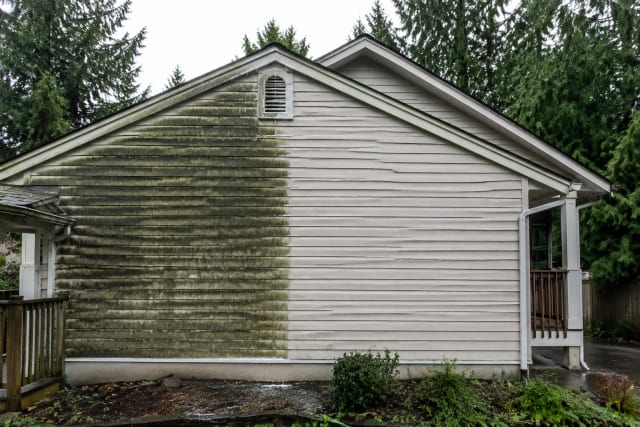
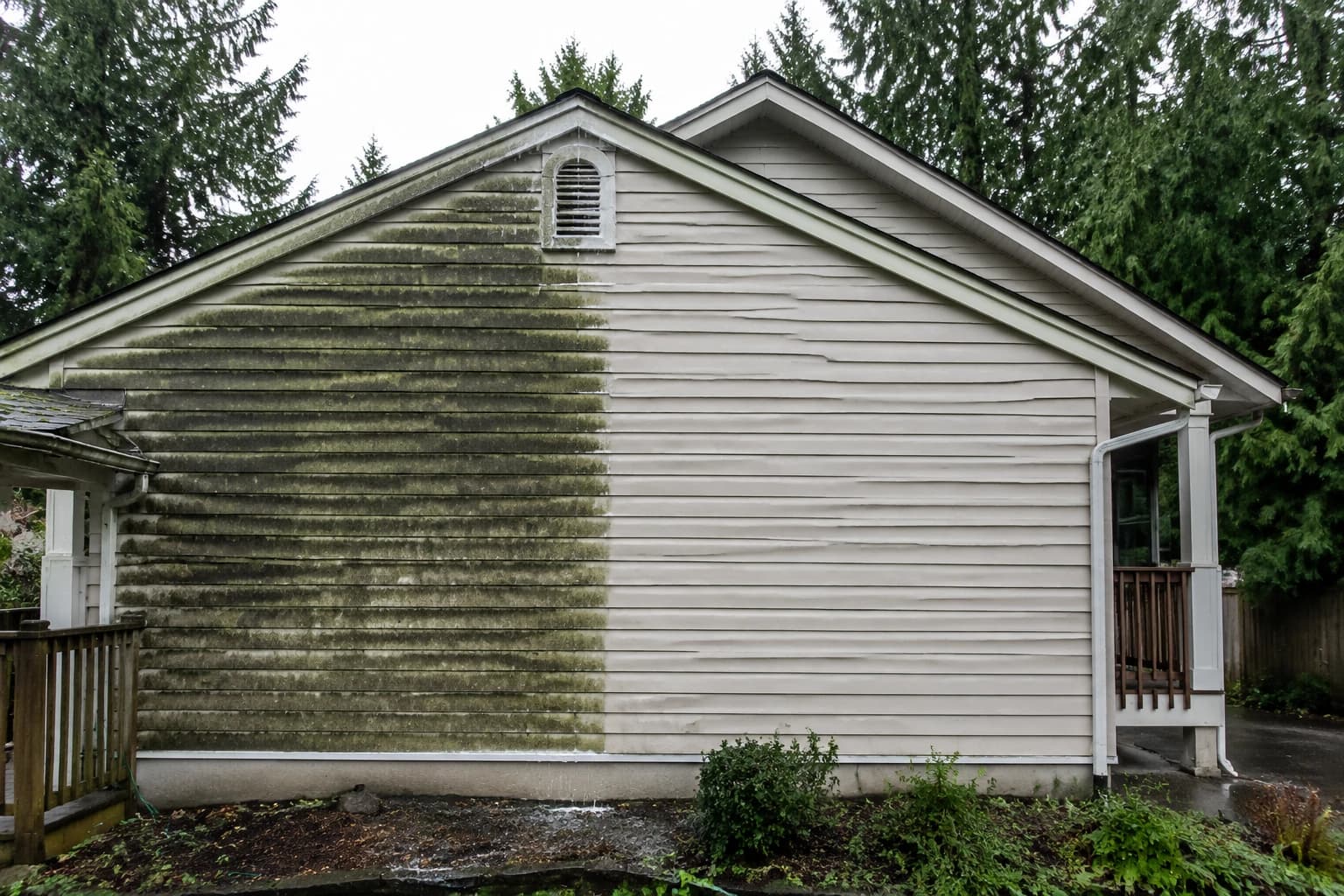
The pressure washing tips that matter most: match the pressure to your cladding, since James Hardie caps pressure washing of its fiber cement at under 1,500 psi from six feet back. Start wide and close in until the grime lifts. Spray downward so water never gets behind the siding. Give moss and algae dwell time instead of pressure. Check the Metro Vancouver restriction stage first.

Key Takeaways
- 1Stage 1 of Metro Vancouver's Drinking Water Conservation Plan takes effect automatically every year from May 1 to October 15, which covers the entire pressure washing season.
- 2Under Stages 1 and 2 a homeowner may wash an impermeable surface only for health or safety, or to prep it for paint; purely cosmetic washing is reserved for a commercial cleaning operation.
- 3Metro Vancouver's definition of an impermeable surface reaches past the driveway: glass, wood, concrete, asphalt and paving stones, on the ground or on a building exterior. A cedar deck and a siding wall are both inside the rule.
- 4James Hardie caps pressure washing of its fiber cement siding at wide fan tips, a minimum six-foot standoff and under 1,500 psi, and prefers low-pressure water with a soft nonmetal brush over a machine entirely.
- 5Get the pressure wrong and it is not just cosmetic: James Hardie states that damage from improper cleaning or maintenance may fall outside its warranty, and lists sand blasting and acid washing as not recommended at all.
- 6Moss and algae are biological, not mechanical: they root into surface pores, so a pressure-only pass takes the top off and leaves the roots to grow back, while a cleaning solution left to dwell removes the organism itself.
- 7BC's Occupational Health and Safety Regulation requires a fall protection system where a fall of 3 m or more may occur, which is the standard a hired crew works to and a useful line for deciding when to stop.
Pressure Washing Tips Start With the Restriction Stage, Not the Machine
In Metro Vancouver, whether you may pressure wash your own siding is a regulatory question for most of the year, not a matter of preference. Almost every pressure washing guide online misses this because almost every one of them is written somewhere else.
- Stage 1 of Metro Vancouver's Drinking Water Conservation Plan comes into effect automatically each year on May 1 and runs until October 15. That is the whole dry season, which is also the whole pressure washing season. Under Stage 1 and Stage 2, washing impermeable surfaces is prohibited except for a health or safety reason, to prepare a surface for painting or similar treatment, or for aesthetic cleaning by a commercial cleaning operation.
- Read the definitions and the scope gets wider than most people assume. The plan defines an impermeable surface as a material added to the surface of the ground, or on the exterior of a building or structure, that is impermeable to water, including glass, wood, concrete, asphalt and paving stones. Your cedar deck, your driveway, your patio slabs and the outside walls of your house are all inside that definition. A commercial cleaning operation is defined just as plainly: a company, partnership or person offering cleaning services to the public for a fee, with pressure washing named specifically.
- So the practical reading is this. Green algae making your back steps slippery is arguably a safety reason and you can deal with it. Washing the whole south wall because it looks dull is aesthetic, and during the plan period that exemption belongs to a hired crew rather than to your own machine. Stage 3 tightens further, dropping the standalone aesthetic exemption altogether, and Stage 4 permits washing only when a regulatory authority orders it for health or safety. Stages move with the reservoir levels through the summer, so check the current restriction stage on the day you plan to work rather than relying on what was true in June.
- None of this makes a pressure washer useless. It shifts the timing. October 16 through April is unrestricted, which is why so much exterior washing in the Lower Mainland happens in shoulder season. If the surface genuinely cannot wait and the restriction rules out the machine, hand cleaning is still available to you: our guide to cleaning a patio without a pressure washer walks through the method we use when a machine is off the table.
Quick Win
Screenshot the restriction page the morning you wash. If a neighbour or a bylaw officer asks, the stage in effect and the reason you were washing are the only two facts that matter, and both are easier to explain on the spot than after the fact.
Identify Your Cladding Before You Pick a Pressure
There is no single safe PSI for a house. There is a safe PSI for vinyl, a different one for cedar, a different one again for stucco, and for fiber cement there is a published manufacturer limit that most owners have never seen.
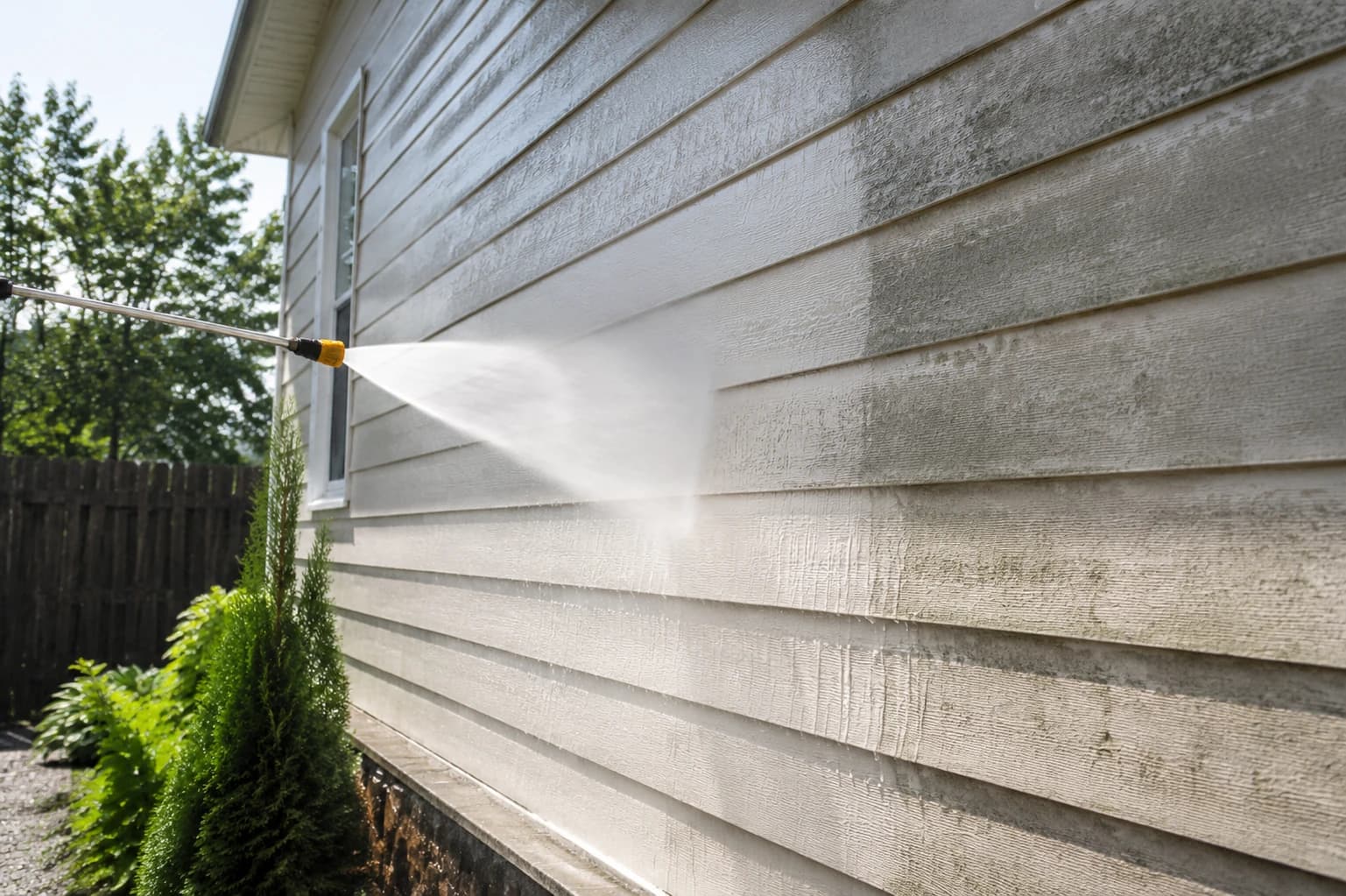
- A large share of Lower Mainland housing built or re-clad since the leaky-condo era wears fiber cement board, and fiber cement has the clearest published guidance of any common cladding. James Hardie's cleaning bulletin states that low pressure water spray with a soft nonmetal bristle brush is most suitable for its products, and that if a pressure washer is used, wide fan tips kept a minimum of 6 feet from the wall at pressures under 1,500 psi will minimize the chance of damage. Six feet back is much further than instinct suggests, and 1,500 psi is well below what a mid-range consumer machine delivers at the trigger.
- The same document adds the line that turns this from a cosmetic question into a financial one: damage to siding arising from improper cleaning or maintenance may not be covered by the James Hardie warranty. Sand blasting and acid washing are both listed as not recommended. If you are a few years into a long cladding warranty, an afternoon with a red tip is an expensive way to save a service call.
- Most owners are not certain what they are looking at, so start with a knuckle. Tap the wall. Vinyl sounds hollow and flexes under a thumb. Fiber cement gives a dull, solid thud and does not move at all. Cedar shows grain, and end grain at the board ends. Stucco is a troweled coat you can feel the sand in. If a board has ever been cut or damaged, the exposed edge settles it: fiber cement is grey cement right through, while vinyl is the same colour on both faces and thin enough to bend in your hand. In a townhouse or a strata, the depreciation report usually names the original cladding product by brand, which beats guessing from the sidewalk.
- Then treat the numbers you find online as ranges rather than rules, because they genuinely conflict between sources. Vinyl is the clearest example of the problem: the figures you will see quoted run from a few hundred psi on one contractor's page to around 2,000 psi on another, and not one of those pages is written by a siding manufacturer. Wood and cedar want considerably less than any of them, because pressure raises and fuzzes the grain, and stucco is porous enough to chip if you work close or square to the wall. Whatever range you land on, the safe move is identical: find the manufacturer's own document for your specific product first, and only then pick a setting.
Quick Win
Cedar tells you the pressure was too high before the damage is obvious. Run a hand over a dried test patch. If it feels fuzzy rather than smooth, you have lifted the grain, and that surface now needs sanding before it can take stain.
Start With the Widest Tip and the Greatest Distance, Then Close In
Nobody blows out a board at a metre with a 40-degree tip. They do it at 20 centimetres with a yellow one, because that is where they started rather than where they ended up. Working from gentle toward aggressive is the whole technique.
- On virtually every consumer machine sold here, nozzle tips are colour coded by spray angle, and the colours mean the same thing across brands. The white 40-degree and green 25-degree tips spread the water across a wide arc and are what belongs on a house. The yellow 15-degree tip concentrates it considerably and has a narrow role on hard flatwork. The red 0-degree tip is a pencil-thin jet that has no business anywhere near siding, window frames, trim or soft wood, and is the single fastest way to gouge a surface you meant to clean. Many machines also ship with a black soaping tip, which drops the pressure so detergent can be applied without blasting it straight back off.
- Distance does the rest of the work. The same tip is a different tool at 30 centimetres than it is at a metre. Start with the widest tip you own, stand further back than feels productive, and close in slowly until the grime lifts. The moment it lifts, stop closing in. That is your working distance for the whole wall.
- Test where a mistake will not show. Pick a patch behind a downspout, under a deck, or on a side elevation nobody looks at, run your intended tip and distance across it, and let it dry fully before you judge. Wet siding hides both the streaking and the surface damage you are checking for. Most people discover the problem only after the whole wall is done.
Quick Win
Squeeze the trigger with the wand pointed at the ground before you bring it to the wall. Machines spit a short high-pressure surge on start-up, and you want that surge landing on the lawn rather than on the one board at eye level.
Spray Down and Across, Never Up Under the Laps
Lap siding is built to shed water that runs down it. Point a pressure washer upward and you are deliberately driving water the one direction the assembly was never designed to handle.
- Every horizontal board on your house overlaps the one below it, so rain runs down the face and away. A pressure washer aimed upward pushes water under those overlaps and into the wall cavity behind them. In a dry climate that water eventually leaves. On the South Coast, in a shaded cavity, it becomes exactly the damp that grows the mould you were trying to wash off the outside. This is the mistake with the longest delay between cause and consequence, and it is the reason a cheap afternoon can turn into a building envelope conversation.
- Work the way the wall works. James Hardie's bulletin puts it plainly for fiber cement: clean a small section at a time, start from the top and work down to prevent dripping or streaking onto areas you have already cleaned, and move along the direction of the plank. That advice holds for almost any lap cladding. Keep the wand roughly level or angled slightly downward, sweep side to side, and let gravity carry the dirty water off the surface instead of fighting it.
- Give glass a wide berth. Window seals, older single-pane units and the flexible sealant around frames all fail faster under direct pressure than the siding around them does, and water pushed past a seal shows up as fogging weeks later. Glass is best finished by hand, which is why we handle it as window cleaning rather than as part of the wash.
Quick Win
Watch the water at the bottom of the wall, not the spot you are spraying. If runoff is coming out clean well below where you are working, the pressure is doing its job. If it is only dirty right at the nozzle, you are cleaning a stripe rather than a wall.
Moss and Algae Need Dwell Time, Not More Pressure
The green film on a North Shore wall is a living organism with roots in the surface pores. Pressure knocks the top off it. Chemistry is what actually removes it, and this is the mistake we see more than any other in the Lower Mainland.
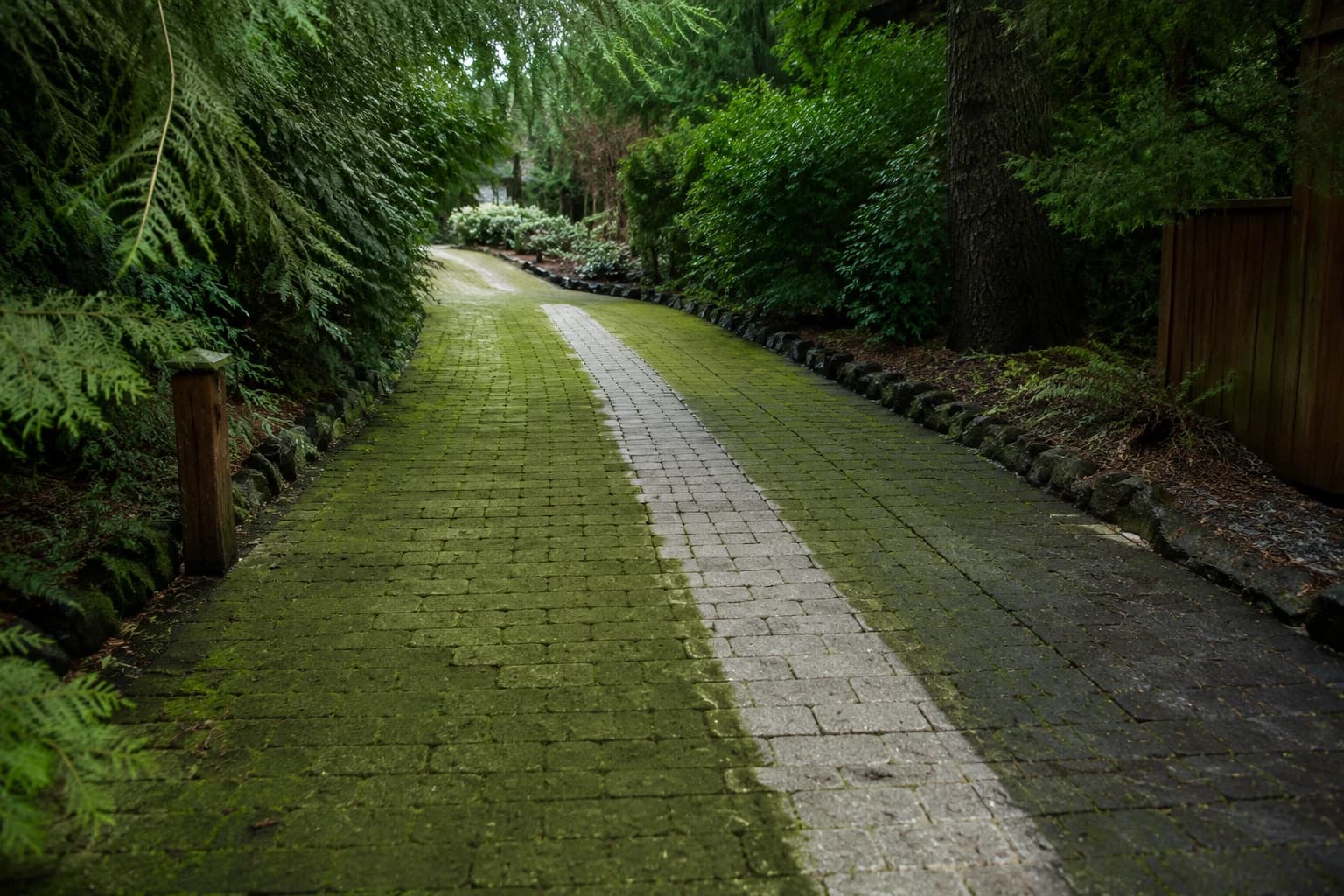
- Dirt sits on a surface. Algae, moss and lichen grow into it. A pressure-only pass looks brilliant on the day, then greens up again from the roots you left behind. Cranking the machine to compensate makes it worse in two directions at once: you still do not reach the organism, and you open up the pores of stucco, concrete or aged wood so the next colony has somewhere better to live.
- The sequence that works is apply, wait, rinse gently. Put down a cleaning solution appropriate to the surface. Let it sit long enough to work without drying on the material, then rinse at the lowest pressure that carries the residue away. On a shaded north-facing wall, or on pavers under cedars, that approach has a name: soft washing. It does the job the pressure never could. Shield your planting beds first. The same James Hardie bulletin that sets the pressure limit for fiber cement also tells you to wear gloves and eyewear and to protect landscaping and vegetation before you start.
- Timing matters as much as method. Growth in shaded North Vancouver and West Vancouver properties comes back on a seasonal cycle, and washing at the wrong point in that cycle means paying to clean the same wall twice. We covered which months actually hold in the best time to pressure wash a house in Vancouver, and the short version is that the calendar does more for you here than the pressure dial does.
Quick Win
Solution dries fastest on the surfaces you can see, which is why streaks appear on sunny elevations. Work the shaded side of the house at midday and save the sunlit walls for late afternoon, and you will spend far less time chasing dried residue.
Keep Dish Soap Out of the Detergent Tank
It is the shortcut we get asked about more than any other. Dish soap in a pressure washer is a bad trade: a little cleaning power now, a clogged injector and hardened seals later.
- Consumer machines pull detergent through a siphon injector sized for thin, low-foaming, pressure-washer-rated solutions. Dish soap is engineered to do the opposite. It is thick, it foams aggressively, and on a hot day it can gum the injector passage and leave residue in the pump seals. That is a slow failure, not a dramatic one. People report it worked fine the first time, then find the detergent function dead the following spring.
- It also rinses badly. Dish soap is built to be flushed off dishes under a running tap, not off a two-storey wall by a rinse pass at distance. What stays behind dries as a faint film that catches dust, so the wall ends up looking slightly worse than it did before you washed it. On glass and dark-painted trim the film is visible in direct light.
- If you want the cleaning power without the machine damage, apply the solution separately. Mix it in a pump sprayer or a bucket, put it on the surface by hand, give it dwell time, then use the pressure washer purely as a rinse with plain water. You get better contact time than the injector would ever deliver, and nothing unusual goes through the pump.
Quick Win
Run about a minute of clean water through the detergent line at the end of every session, even when you used the correct product. Anything left in that line is sitting against seals until the next time you pull the machine out, which around here can be nine months.
Protect Everything the Water Will Find on Its Way Past
Pressurized water travels well past the arc you are aiming at, and ten minutes of covering up prevents the damage that costs more than the cleaning was ever worth.
- Walk the elevation before you start and deal with what is on it. Exterior outlets and light fixtures should be covered and, where you can, switched off at the panel. Gas and electrical meters, doorbell cameras, vents and the dryer exhaust hood all take water badly and are easy to tape over. Weep holes at the base of the cladding are meant to let moisture out, not to take a jet in, so keep the wand off them. Open windows are obvious until you are three walls in and have forgotten the bathroom. A wall's worth of dirty runoff across an interior floor is the one part of an exterior job that ends up as house cleaning.
- Planting beds need attention too. A stream that strips lichen off concrete will also strip leaves off a hydrangea and wash the mulch off the bed behind it. Wet the plants down with plain water first so they are not absorbing concentrated solution, drape what you can, and rinse the beds afterward. Cleaning products carried into soil do more harm at ground level than the same product did on the wall.
- Then look after yourself. Gloves, eye protection, closed-toe shoes with grip, and long pants, on a surface that is now wet and slick. High-pressure water can break skin at surprisingly low settings, and an injection wound looks minor at the time while being an urgent problem underneath. If a jet catches your hand, treat it as an emergency room visit rather than a first aid kit issue.
Quick Win
Count your covers out loud when you put them on, and count them again before you pack up. Tape left over a dryer vent, a bathroom fan or a weep hole does more damage across the following week than the water would have done in the afternoon, and the ones high on the wall are the ones nobody remembers.
On Driveways and Pavers, the Mistake Is Stopping Halfway
Flatwork is where a pressure washer is genuinely the right tool. It is also the only surface that keeps a permanent record of where you stopped for lunch.
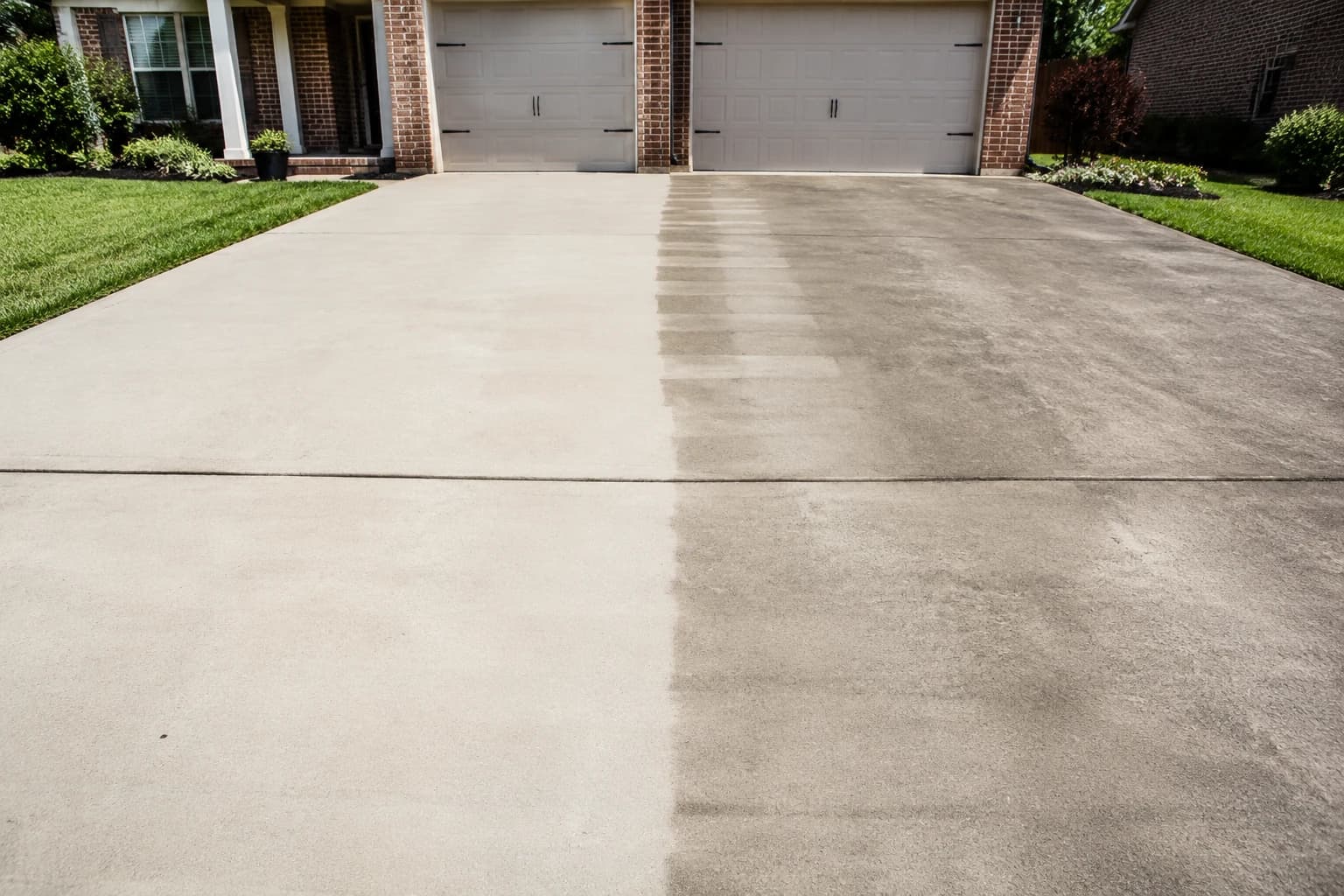
- Concrete cleans in visible passes. Overlap them by a third, keep the wand at a constant height and a constant walking speed, and finish the slab in one session. Change any of those variables partway and you get lap marks: pale stripes and darker edges baked into the surface that read as damage from the sidewalk. Stopping for the day halfway across a driveway is the version of this mistake that stays visible until the whole slab is redone. A surface cleaner attachment, the round housing that rides on the concrete, exists specifically to hold the height and overlap constant, and it is the single best accessory for anyone washing flatwork more than once a year.
- Interlocking pavers have an extra failure mode. The sand packed into the joints is structural, and a narrow tip blasts it out in seconds. Once the joints are empty the pavers rock underfoot, weeds move in, and the bed beneath begins to migrate. Use a wide tip, angle across the joints rather than down into them, and plan to re-sand afterward. Joint sand is cheap and re-sanding is a Saturday. Re-laying a settled patio is not.
- Older concrete deserves a check first. Spalling, hairline cracking and exposed aggregate all mean the surface has already lost its skin, and pressure that a newer slab shrugs off will take more of it away. If you are weighing a full exterior wash against the tools and the weekend, our breakdown of what pressure washing a house costs in Metro Vancouver lays out the numbers on both sides.
Quick Win
Wash flatwork in the direction water already drains, and finish each pass at the low edge. Dirty runoff that crosses concrete you have already cleaned will dry as a tide line, and no amount of extra pressure removes a tide line without redoing the whole slab.
Anything Above Ladder Height Is Where DIY Stops
Most guides end with a vague suggestion to call someone if you are unsure. Here is a firmer line, borrowed from the standard that professional crews in this province already work to.
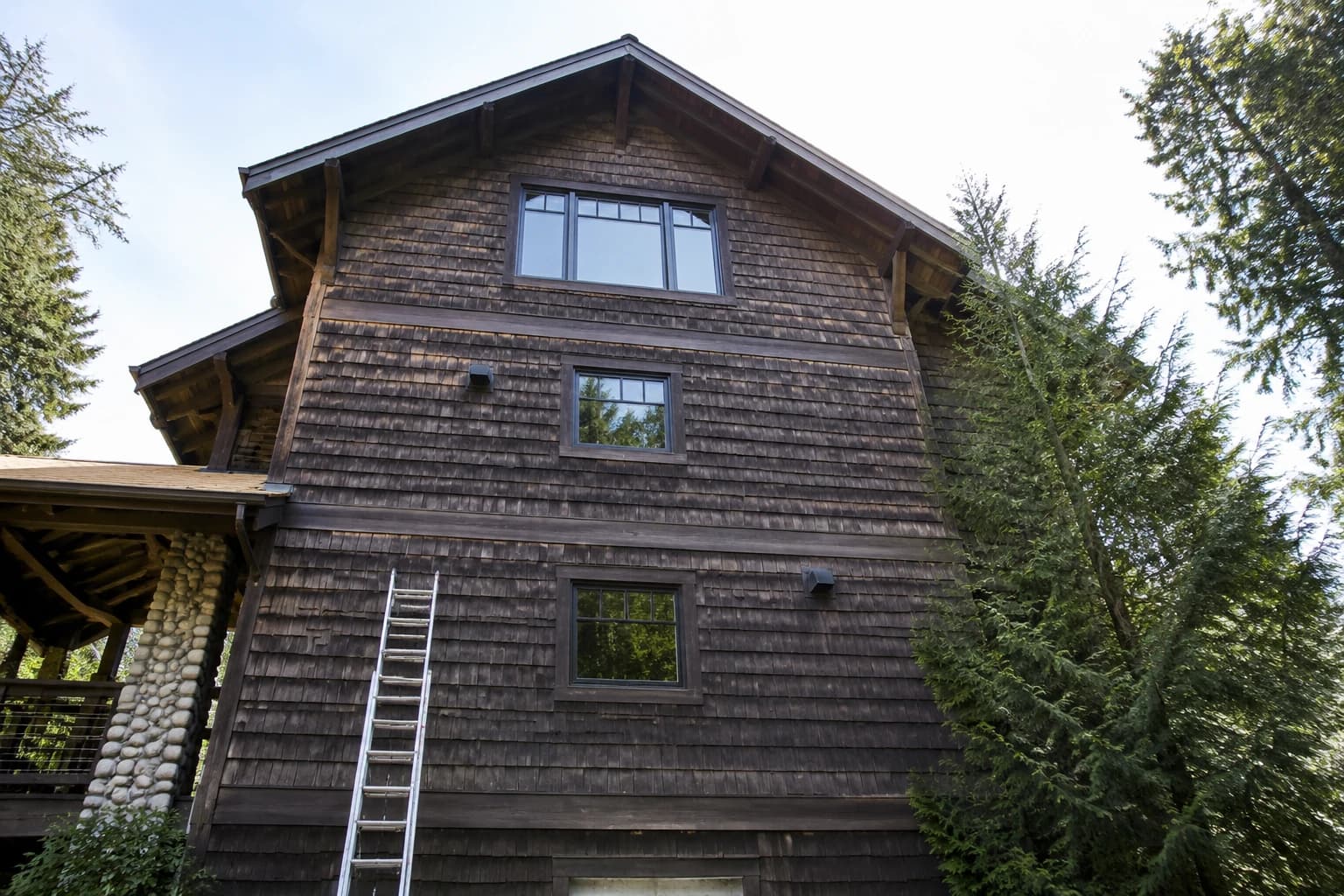
- BC's Occupational Health and Safety Regulation requires a fall protection system where work is done at a place from which a fall of 3 m or more may occur. It applies below 3 m too, wherever the risk of injury is greater than the impact of hitting a flat surface. That obligation sits on employers, not on homeowners, so nobody is going to ticket you for washing your own gable. It is still the most useful number in this article, because it is the height at which people who do this every day stop relying on balance and start using equipment.
- Add the physics. A pressure washer wand pushes back when you pull the trigger, the reaction increases as you narrow the tip, and you are absorbing it while standing on a ladder with wet hands, on ground you have just made slippery, holding a hose that wants to pull you sideways. Two-storey walls with a gable, common on the North Shore and on sloped Vancouver lots, put the top course well past the point where any of that is sensible. Extension wands help you reach without climbing, though they trade away precision and get heavy fast.
- There are three other honest stopping points. If your cladding manufacturer specifies a pressure your machine cannot reliably hold, the machine is the wrong tool. If you live in a strata, the exterior cladding is usually common property and washing it yourself may not be your call, so check the bylaws before you check the weather. And if the water restriction stage puts aesthetic washing outside what a personal machine may do, that decision is already made for you.
- That last one is where hiring out stops being about convenience. Under Stages 1 and 2 the exemption for aesthetic cleaning is written specifically for a commercial cleaning operation, and that is the category our pressure washing service sits in. It is also why a crew arrives with a fall protection plan and a pressure set to the cladding rather than to the machine's maximum.
Quick Win
Before you commit to a weekend, price the rental, the surface cleaner attachment, the right detergent and the tips you do not own yet, then compare that against a quote. On a single-storey house the DIY route usually still wins. Above one storey, the gap closes faster than most people expect.
Fast Reset
Quick Checks Before You Pull the Trigger
Services mentioned in this article
Ready for help?
4.9 · 850+ Google reviewsLooking Up at a Wall You Would Rather Not Climb?
If the algae is above ladder height, your cladding has a pressure limit you would rather not test, or the restriction stage rules out your own machine, that is exactly the job to hand over. We match the pressure to the surface, work to the fall protection standard, and clean as a commercial operation under the regional water rules.
778-720-2224Pressure Washing Questions We Get From Vancouver Homeowners
What is the best technique for pressure washing?
Start with the widest nozzle and the greatest distance, then close in slowly until the grime lifts and stop there. Work top to bottom in small sections, sweep side to side along the direction of the boards, and keep the wand level or angled slightly downward so water never travels up under the laps. Test on a hidden patch and let it dry before judging, because wet surfaces hide both streaking and damage.
What should you not do when pressure washing a house?
Do not use a red 0-degree tip on siding, do not spray upward under lap boards, and do not aim directly at windows, seals, weep holes, meters or light fixtures. Do not treat moss and algae as a pressure problem, because the roots sit below the surface. And do not work from a ladder: the wand kicks back when you pull the trigger, and you are standing on a surface you have just made wet.
Can I put Dawn dish soap in my pressure washer?
It is not worth it. Consumer detergent injectors are sized for thin, low-foaming, pressure-washer-rated solutions, and thick dish soap can gum the injector passage and leave residue in the pump seals. It also rinses poorly off a large wall and dries as a film that catches dust. Apply your cleaning solution with a pump sprayer instead, give it dwell time, then run plain water through the machine as a rinse.
What PSI should I use to pressure wash siding?
It depends entirely on the cladding, so find the manufacturer's own document before you touch the machine. James Hardie caps pressure washing of its fiber cement at wide fan tips, a six-foot standoff and under 1,500 psi, and says damage from improper cleaning may fall outside its warranty. Vinyl tolerates more, cedar and stucco want less, and the published ranges for those materials disagree sharply between sources, none of which is a manufacturer.
When should I call a pro instead of pressure washing myself?
Call a pro once the wall goes above safe ladder height, or when your cladding's published pressure limit is lower than your machine can reliably hold. Professional crews in BC work to a fall protection standard that kicks in at three metres, and a pressure washer wand kicks back hardest at exactly the moment you are least stable. Two other clear stopping points: strata bylaws usually put shared exterior cladding outside an individual owner's control, and while a Metro Vancouver restriction stage is active, cosmetic washing is carved out for licensed cleaning businesses rather than personal machines.
Sources & References
The facts in this guide come from the primary sources below. Links open in a new tab.
- 1Drinking Water Conservation Plan (washing impermeable surfaces, Stages 1 to 4, and definitions)Metro Vancouver
- 2Water restrictions and the currently active stageMetro Vancouver
- 3Technical Bulletin #20: Cleaning James Hardie Primed and ColorPlus Technology SidingJames Hardie
- 4Occupational Health and Safety Regulation, Part 11: Fall Protection, section 11.2BC Laws

Meet the Author
Pamela
Co-Founder
Pamela leads residential quality standards at P&J Cleaners, refining safe, detail-driven cleaning systems for Vancouver homes, condos, and move-out projects.
Keep Exploring