

Industry Overview
What an Airbnb Cleaning Service Costs a Metro Vancouver Host in 2026
Most cleaning fee advice online is American, and it is priced for American labour. That matters more than it sounds. B.C.'s general minimum wage rose to $18.25 an hour on June 1, 2026, and an insured cleaning company carrying WorkSafeBC coverage, liability insurance, vehicles and supplies prices well above that floor. In practice, turnover work across Metro Vancouver sits at $40 to $60 per cleaner per hour, which is the same band that governs standard residential visits here.
The second thing that separates this market is regulation. Since May 1, 2025, every short-term rental host in the province has had to be registered with B.C.'s short-term rental registry with the registration number displayed on the listing. Vancouver layers its own business licence on top at $1,108 a year plus a $77 application fee, per the City of Vancouver short-term rental licence page. Those are fixed costs that have to come out of the same revenue as your cleaning.
Third, Vancouver hosts are mostly single-unit operators. The province's principal residence requirement applies in municipalities of 10,000 people and over, including Vancouver, and limits short-term rentals to the home you actually live in plus one secondary suite or accessory dwelling on the same property. One unit means no route density, no volume discount and no spare afternoon to absorb a late checkout. Every turnover is priced on its own.
$18.25/hour
B.C. general minimum wage
Source: Province of BC, effective June 1, 2026
$1,108/year
Vancouver short-term rental business licence
Source: City of Vancouver
$100/year
B.C. registry fee, principal residence
Source: Province of British Columbia
$3,000
Maximum municipal fine, per infraction per day
Source: Province of British Columbia
$130 to $180
Typical one-bedroom turnover
Source: P&J Cleaners 2026 Metro Vancouver rates
5%
GST on cleaning services in B.C.
Source: Canada Revenue Agency
Compliance priorities
Display your provincial short-term rental registration number on every listing, on every platform, without exception • Hold a current City of Vancouver short-term rental business licence and show the licence number in the listing where your local government requires one • Operate from your principal residence where the provincial requirement applies, which covers Vancouver and every B.C. municipality of 10,000 people and over • Confirm your strata bylaws permit short-term rental before you book anything, because a valid licence does not override a bylaw • Keep smoke and carbon monoxide alarms tested and documented between guests, since your cleaner is the last person in the unit before check-in • Expect 5 percent GST on cleaning invoices and treat it as a business input cost, not a surprise
What Drives Your Turnover Price, and What to Charge For It
Five things decide what you pay per turnover here: unit size, the length of your window, whether linens leave the building, how much restock and staging you want, and what it takes to get into the building. Once you know your own number, the last section covers what to charge the guest.
How Much Does an Airbnb Turnover Cost by Unit Size?
The bands most Metro Vancouver hosts land in, and the crew-hour math that produces them.
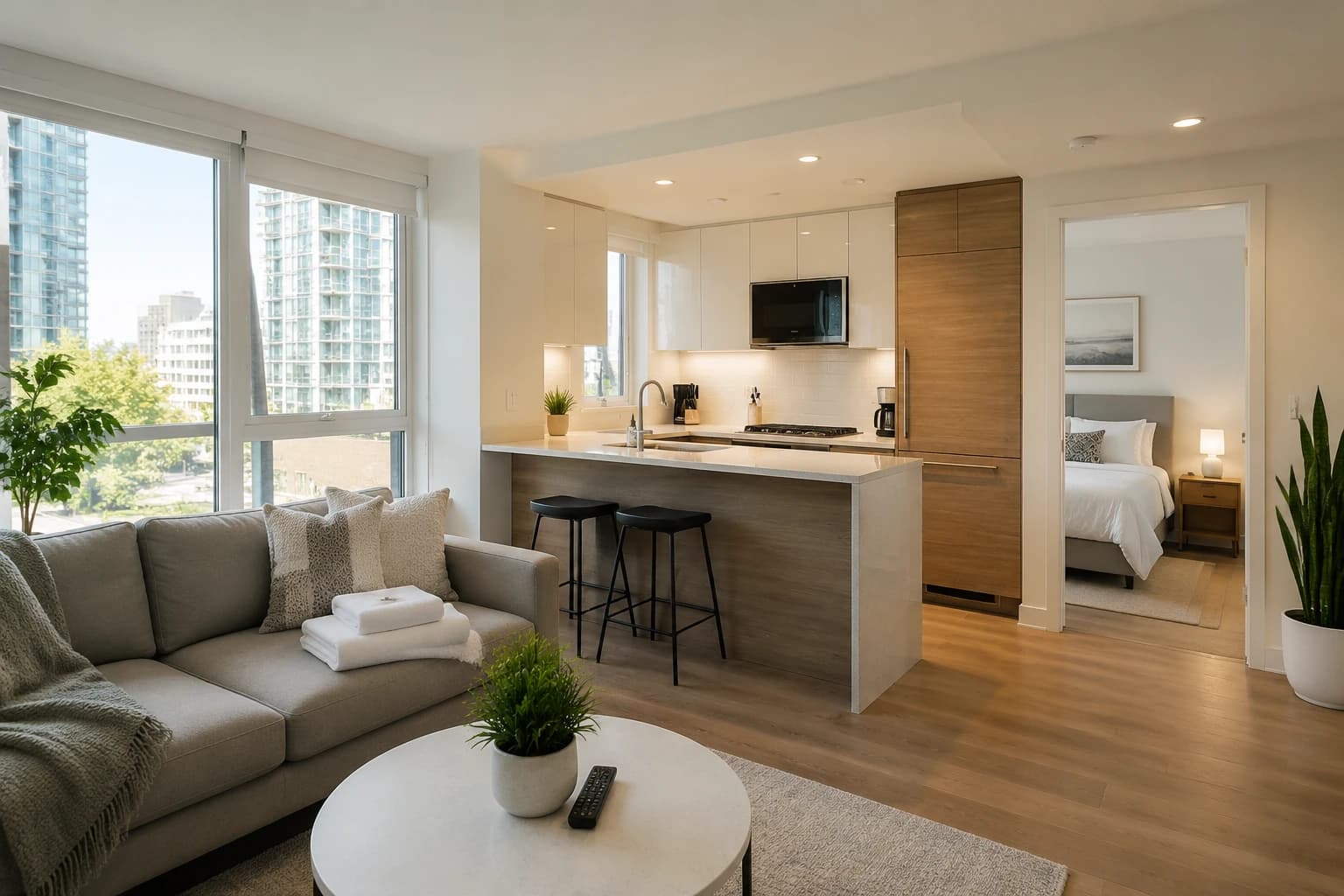
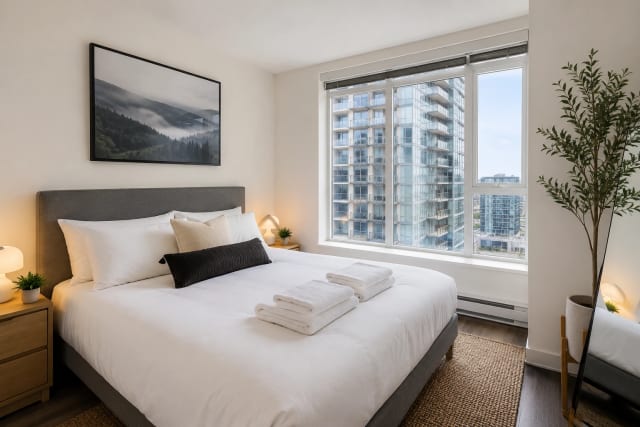
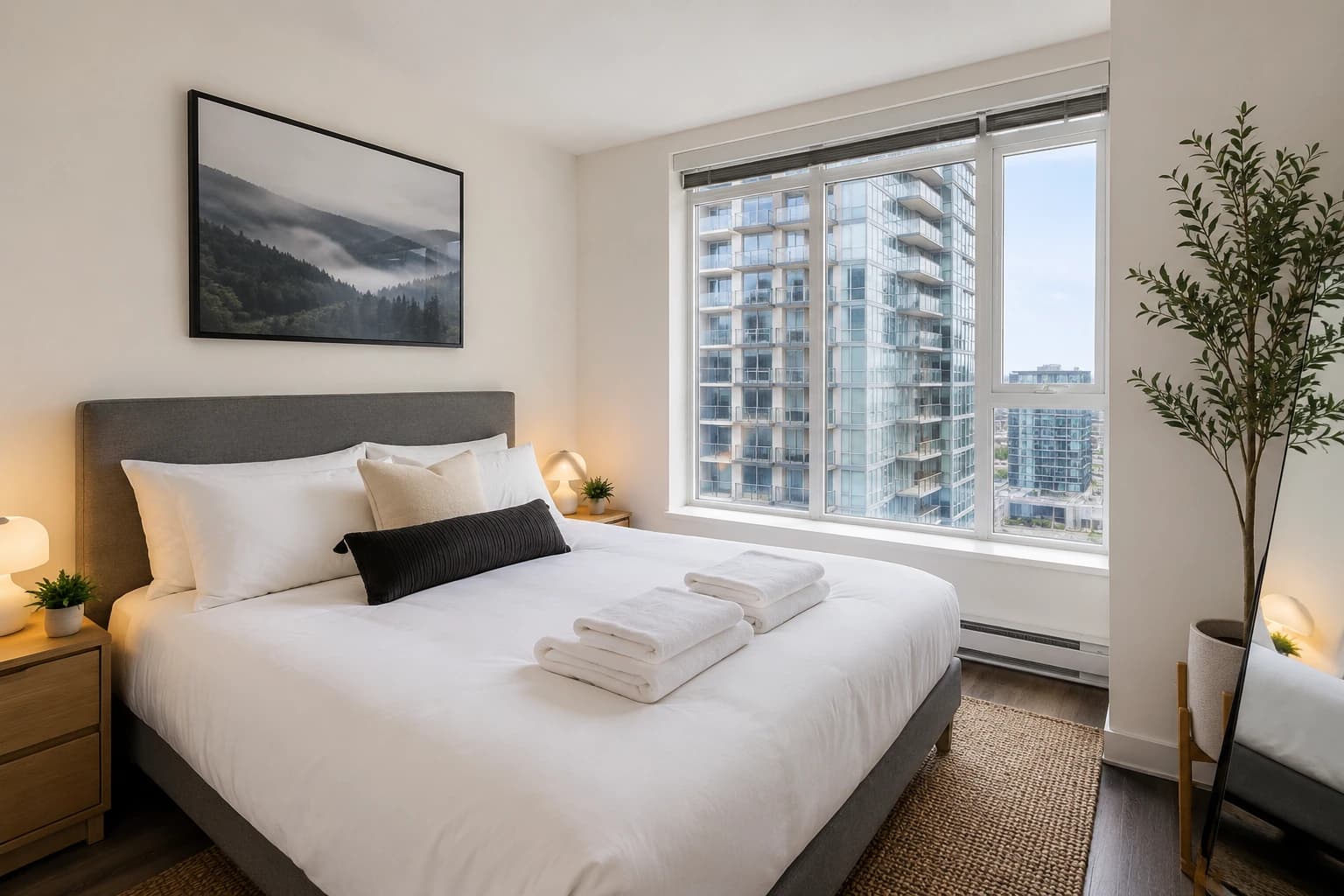
A turnover is not a lighter version of a house clean. It is a full reset with a deadline. Strip and remake beds, reset the kitchen and bathrooms, wipe every touch point, vacuum and floor-wash. Then stage the space so the first photo a guest takes looks like the listing, and report anything the last guest damaged. Metro Vancouver crews price that work at $40 to $60 per cleaner per hour, and every visit also carries travel, supplies and building access time on top of the hours spent cleaning, which is why the flat bands below sit above a straight hours-times-rate figure.
A studio or junior one-bedroom absorbs roughly 1.5 to 2 cleaner-hours and lands at $110 to $150. Add a bedroom and you are at 2 to 3 cleaner-hours, or $130 to $180, which is where most downtown listings sit. The jump to a two-bedroom is bigger than hosts expect: 3 to 4 cleaner-hours and $170 to $240, because a second bathroom and a second bed set are where the time actually goes. Three-bedrooms and townhouses run $220 to $320, and a detached house with four bedrooms or more starts around $350. Add 5 percent GST to all of it.
If a quote comes in far under those numbers, ask what is missing rather than assuming you found a deal. The usual answers are linens billed separately, no restock, no damage reporting, or an unbonded solo cleaner with no coverage if something goes wrong in your unit. These bands sit on the same hourly base as ordinary residential work, which our Vancouver apartment cleaning cost guide walks through in detail. Our own Airbnb turnover cleaning service quotes flat per turnover with the inclusions written out, so you can hold any quote line by line against it.
- Studio or junior one-bedroom: $110 to $150 per turnover, about 1.5 to 2 cleaner-hours
- One-bedroom, one bathroom: $130 to $180 per turnover, about 2 to 3 cleaner-hours
- Two-bedroom, one or two bathrooms: $170 to $240 per turnover, about 3 to 4 cleaner-hours
- Three-bedroom or townhouse: $220 to $320 per turnover
- Detached house, four bedrooms or more: from about $350 per turnover
- Hourly alternative: $40 to $60 per cleaner per hour, useful for odd-shaped units and mid-stay refreshes
- All bands are before 5 percent GST, and none of them include linen laundering
Why the Same-Day Window Is the Real Cost Driver
An 11am checkout and a 3pm check-in is a four-hour operating window, not a flexible afternoon.
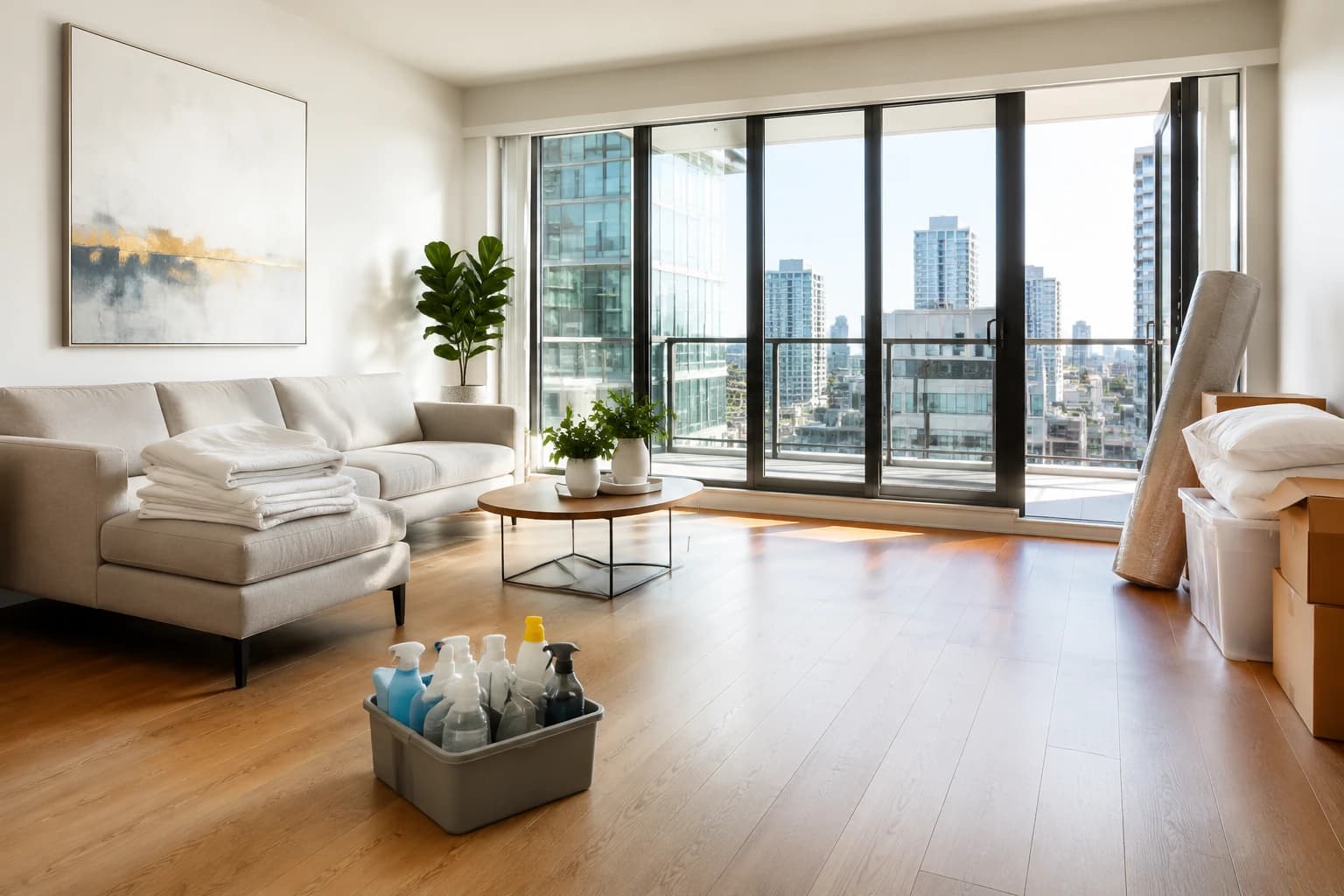
Most Vancouver listings run an 11am checkout and a 3pm check-in. That looks like four hours. It is not. Take out travel between jobs, the guest who leaves at 11:20, the elevator booking and the trip back to the car for the linen swap. On a back-to-back day the real cleaning window is closer to two hours. Guaranteeing a crew inside it means holding capacity that cannot be sold to anyone else, which is why it carries a premium of roughly 15 to 25 percent over a flexible-window turnover.
The cheapest thing a host can do is give the window room. If your calendar allows a same-day gap only on weekends, book flexible windows Monday through Thursday and pay the rush premium only when the booking pattern forces it. Hosts who batch their guaranteed slots into two or three predictable days a week usually pay less over a month than hosts who send every job in as an emergency.
The other lever is scope discipline. A crew working a tight window has to know exactly what is in scope before they walk in, because there is no time to make judgment calls at 1:40pm. A written turnover standard fixes that, and our nine-step Airbnb turnover checklist is the same sequence our crews run in the field.
- Guaranteed same-day window: expect a 15 to 25 percent premium over a flexible booking
- Real working time inside an 11am to 3pm window is often closer to two hours once access and travel come out
- Late checkouts are the single most common cause of a missed check-in, so decide in advance who absorbs the delay
- Batch your guaranteed slots onto predictable days instead of paying rush pricing seven days a week
- A written scope removes mid-clean decisions, which is where tight windows usually break
- Ask whether your crew photographs the finished unit, because that is your evidence if a guest disputes cleanliness
Recommended Frequency
Book guaranteed same-day windows only for genuine back-to-back stays. On single-turn days a flexible four-hour window costs less and delivers the same result.
Linens, Restock and the Add-Ons That Move Your Number
The line items that separate a $140 turnover from a $195 one, and which of them are worth paying for.

Linen is the add-on that surprises new hosts most. A one-bedroom turnover generates a full bed set plus four to six towels, and a stacked in-suite washer-dryer cannot process that inside a same-day window. It physically cannot: one wash and dry cycle on a condo stacker runs past two hours. So either you own two or three complete sets and swap them, or you pay for off-site laundering at roughly $25 to $45 per turnover set. Owning spare sets is almost always cheaper by the second month, and it is the single best purchase a new host makes.
Restock is smaller but easier to get wrong. Coffee, tea, paper products, dish tabs, soap and bin liners are a few dollars per stay, but a guest who finds an empty toilet roll holder writes about it. Decide whether your crew carries and bills consumables at cost, or you keep a locked supply cupboard in the unit. Either system works. The three-star review comes from having neither.
Then there is the periodic reset a turnover never covers: window tracks, under-furniture dust, the oven exterior and balcony glass where it is safely reachable. Coastal rain leaves a film on exterior glass faster here than in most markets. Inside the fridge, range hood degreasing and baseboards are booked as add-ons on top of a deep clean, so name the ones you want when you book. Budget the deep clean at roughly 1.5 to 2 times a standard turnover, plus any add-ons, scheduled quarterly or every 8 to 12 stays, whichever comes first.
- Off-site linen laundering: $25 to $45 per turnover set for a one-bedroom
- Two or three complete linen sets typically pay for themselves within the first two months of steady bookings
- Consumable restock: a few dollars per stay, billed at cost or stocked by you in a locked cupboard
- Mid-stay refresh for stays over five nights: usually billed hourly at the standard Metro Vancouver crew rate
- Periodic deep reset: 1.5 to 2 times a standard turnover, quarterly or every 8 to 12 stays
- Damage and missing-item reporting should be included rather than billed as an extra, and photos should be available on request
Recommended Frequency
Deep reset every 8 to 12 turnovers or quarterly, whichever arrives first. Book it in a booking gap, never on a same-day turn.
Tower Access: The 20 Minutes Before Anyone Starts Cleaning
In a downtown tower, part of what you pay for happens before the caddy reaches your door.
A turnover in a Downtown Vancouver or Yaletown short-term rental tower starts with logistics, not cleaning. Visitor parking is often full, the loading bay may need booking, the service elevator may be reserved for moves until noon, and the fob has to be somewhere a crew can reach without a concierge signature. Twenty minutes of that is normal, and it is billable time in every honest quote.
The fix is unglamorous and it works. Set up permanent access: a lockbox in an approved location or a code the crew keeps, cleared with your strata in writing. Tell your cleaner the building's parking situation once, in writing, rather than by text on the day. If the building restricts the service elevator, put those hours in your booking instructions so the crew is never scheduled against them.
Character conversions in Kitsilano and Mount Pleasant have the opposite problem: easy street access, but no elevator, narrow stairs and radiators or original hardwood that add handling time. Neither building type is worse. They just cost differently, and a quote that ignores the difference tends to get revised after the first visit.
- Budget 20 minutes of access time in towers with concierge, loading bay or service elevator restrictions
- Get strata approval in writing for a lockbox or permanent access code before the first booking
- Send parking instructions once, in writing, and keep them in the recurring booking notes
- Flag service elevator restrictions so a same-day turn is never scheduled inside a blackout window
- Walk-up and heritage units trade elevator delays for stair-carry time, so expect similar totals for different reasons
- A crew that already works your building will beat a cheaper crew that has never been inside it
How to Set a Cleaning Fee That Covers Cost Without Killing Bookings
Recover your cost on the fee, put your margin in the nightly rate, and watch what the fee does to short stays.
Airbnb describes the cleaning fee as a one-off charge set by the host, and it is folded into the total price a guest sees before booking. That single detail should drive your whole approach: guests compare totals, not line items. A fee that looks fine on its own can push your total past the listing next door, and short stays are where that bites. On a two-night booking a $150 fee is $75 a night of invisible cost. On a five-night booking it is $30.
The approach that holds up is simple. Set the fee to recover your actual turnover cost, including linens and the rush premium if you routinely pay one. Then take your margin on the nightly rate, where guests are already comparing. If a one-bedroom turnover with linens costs you $185, a fee of $185 is honest and defensible, and rounding to the nearest $5 is as far as you should go. Trying to earn on the fee is how listings end up with a fee that reads as a penalty.
Do not forget the fixed side. A Vancouver host paying the $1,108 city licence and the $100 provincial registration carries roughly $1,210 a year before anything else, closer to $1,290 in the first year with the application fee. Spread across 60 stays that is about $20 per turnover, and it belongs in your nightly rate rather than in the cleaning fee. For one-off jobs like a season opener or a mid-year reset between long gaps, a one-time cleaning is usually the cleaner way to book it.
One myth worth retiring: there is no official 80/20 rule for Airbnb. Search results treat it like platform policy, but it is hosts applying the Pareto principle, the idea that a small share of your effort drives most of your result. Applied to turnovers it is fair enough advice, since beds, bathrooms, floors and smell decide most cleanliness reviews. It is not a rule you can breach, and no part of Airbnb's policy documentation contains one.
- Price the fee to recover cost, not to earn margin, and take profit on the nightly rate instead
- Check the fee as a share of a two-night total, because that is where a high fee costs you bookings
- If you routinely pay a rush premium, build it in rather than absorbing it quietly every week
- Keep licence and registry costs out of the cleaning fee and inside your nightly rate, roughly $20 per stay at 60 turnovers a year
- Revisit the fee twice a year, once before summer and once when your linen or laundering cost changes
- The 80/20 rule is not Airbnb policy, so treat it as a prioritization habit and nothing more
Cleaning It Yourself vs Booking a Crew: The Honest Comparison
The comparison only means something when you price your own hours at what your time is actually worth.
Plenty of Vancouver hosts clean their own units, and for a host living in the building with a flexible schedule that can be the right call. The math changes the moment your own hours have a price. A one-bedroom turnover done solo takes most hosts 2 to 3 hours including the linen run, and it has to happen inside a fixed window on someone else's schedule. At 60 stays a year that averages a little over one turnover a week, and four to six hours in a busy one, on a schedule you cannot move.
Then there is the failure cost, which is the part hosts underestimate. A missed window means a guest waiting in a lobby with luggage. A rushed clean means a cleanliness review that sits on the listing for months and quietly drags conversion. Those outcomes are rare, but they are expensive when they land, and they are exactly what a professional crew with backup capacity is for.
Run the comparison against a real hourly value for your time rather than treating your own labour as free. At 60 turnovers a year, a solo host spends roughly 150 hours on turnovers. Priced at even $30 an hour, that is $4,500 of your time, plus $1,200 to $2,400 in supplies, laundry and consumables. Set that against roughly $9,800 to $12,000 of crew invoices, which is 60 one-bedroom turnovers at a typical $155 to $190 with linens included, plus 5 percent GST. The gap is real, and what it buys is about 140 of those hours back, insurance, backup staffing for the week you are sick, and documentation you would otherwise have to produce yourself.
Cleaning it yourself
- Out of pocket: supplies, laundry and consumables, roughly $20 to $40 per turnover
- Your time: 2 to 3 hours per one-bedroom turnover including the linen run
- Schedule: locked to an 11am to 3pm window you cannot move
- No backup if you are sick, away or stuck in traffic on the day
- No liability coverage or WorkSafeBC protection if something goes wrong in the unit
- Documentation and damage photos only get done if you remember to do them
Booking a turnover crew
- Flat cost: $130 to $180 per one-bedroom turnover, plus linens and GST
- Your time: about 10 minutes of coordination per stay
- Two cleaners inside the window, so the unit is guest-ready faster
- Backup staffing when your regular crew is unavailable
- Bonded, insured and background-checked cleaners entering your unit
- Damage and missing-item reporting arrives with the job, with photos on request
2 to 3 hours
Host hours per one-bedroom turnover, done solo
60 to 90 minutes
Crew time on site, one-bedroom
about 150 hours
Host hours per year at 60 turnovers
about $20
Fixed licence and registry cost per turnover
15 to 25 percent
Same-day guaranteed window premium
every 8 to 12 stays
Deep reset cadence
- Your calendar stops dictating your week, because the window is someone else's problem to hit
- Cleanliness stops being variable, which is the single review category most tied to repeat bookings
- Damage gets reported the same day, while a claim is still straightforward to make
- Back-to-back bookings become possible, so you stop blocking days you could have sold
- Insurance and WorkSafeBC coverage move off your shoulders and onto the company doing the work
- The standard holds the same the week you are in Whistler or overseas as the week you are home
The Metro Vancouver Host Cost and Compliance Checklist
Everything a Vancouver short-term rental host should have priced, documented and scheduled before the summer booking wave. Tap any card for the full list.
Services mentioned in this article
Ready for help?
4.9 · 850+ Google reviewsWant a Flat Turnover Price for Your Unit?
Send us your building, unit size, and whether you need a guaranteed same-day window. You get back a flat per-turnover rate that spells out exactly how linens, restock and reporting are handled, so you can set your cleaning fee against a real number. Bonded, insured, and 4.9-star rated across 850 reviews in Metro Vancouver.
778-720-2224Airbnb Cleaning Cost Questions Vancouver Hosts Ask
What is a normal cleaning fee for Airbnb in Vancouver?
A normal cleaning fee for a Vancouver one-bedroom lands between $155 and $225, because that is what the turnover costs once linens are included: $130 to $180 for the clean plus $25 to $45 for the linen set. Hosts who own spare sets and launder in-house sit near the bottom of that range. Studios run $110 to $150 and two-bedrooms $170 to $240 before linens. Set the fee to recover your cost rather than to earn on it, since guests compare total prices.
How much do cleaners charge for an Airbnb turnover in Metro Vancouver?
Professional turnover pricing runs $40 to $60 per cleaner per hour, or a flat $110 to $320 per turnover for studios through three-bedrooms, and from about $350 for a detached house with four bedrooms or more. A one-bedroom typically takes two cleaners 60 to 90 minutes on site. Linen laundering, restock and guaranteed same-day windows are priced on top of the base rate.
What is the 80/20 rule for Airbnb?
There is no official 80/20 rule at Airbnb. Hosts use the phrase to describe the Pareto principle, the idea that a small share of your effort produces most of your result. Applied to cleaning it means beds, bathrooms, floors and smell drive most cleanliness reviews, so those get your attention first.
How much is one hour of cleaning in Vancouver?
One hour of professional cleaning in Metro Vancouver costs $40 to $60 per cleaner, before 5 percent GST. A two-person crew therefore costs $80 to $120 for an hour on site. Very few turnovers are booked as a single hour, since even a studio reset with linens takes 1.5 to 2 cleaner-hours.
Should I charge a cleaning fee or raise my nightly rate?
Do both, deliberately. Use the cleaning fee to recover the actual turnover cost and put your margin in the nightly rate. Check the effect on a two-night booking, where a high fee inflates the total a guest sees most sharply and is the most common reason a competitive listing loses a short stay.
How often does a short-term rental need a deep clean?
Every 8 to 12 turnovers, or quarterly, whichever comes first. Turnovers keep a unit guest-ready but do not reach window tracks, under-furniture dust, the oven exterior or balcony glass. Interior fridge, range hood and baseboard work is booked as an add-on, so name it when you book. Schedule the deep reset into a booking gap, never onto a same-day turn, and budget 1.5 to 2 times a standard turnover.
How do I set the right Airbnb cleaning fee in Vancouver?
Add up your real per-turnover cost first: the cleaning band for your unit size, linen laundering at $25 to $45, and any rush premium you routinely pay. Set the fee at that total, not above it, and take your margin on the nightly rate instead. Then sanity-check the fee against a two-night booking, where it inflates the total a guest sees most sharply.
Sources & References
The facts in this guide come from the primary sources below. Links open in a new tab.
- 1B.C.'s short-term rental legislation, registry requirement and penaltiesProvince of British Columbia
- 2Short-term rental host registration and registry feesProvince of British Columbia
- 3B.C.'s short-term rental principal residence requirementProvince of British Columbia
- 4Short-term rental business licenceCity of Vancouver
- 5B.C.'s minimum wage increases to $18.25, June 1Province of BC, Ministry of Labour
- 6What is a cleaning fee and how does it workAirbnb
- 7GST/HST rates by province (GST is 5 percent in British Columbia)Canada Revenue Agency

Meet the Author
Jason
Co-Founder
Jason oversees commercial operations, workflow design, and quality control for office, restaurant, and specialty cleaning programs across Metro Vancouver.
Keep Exploring